HUMAN 3.0 — The Complete Series
HUMAN 3.0 — The Complete Series
Source: Dan Koe — letters.thedankoe.com. All six letters of the HUMAN 3.0 series (Aug 26 – Sep 23, 2025), saved as-is with the original diagrams, merged in publication order.
Part 1: A Map To Reach The Top 1%
Original: HUMAN 3.0 – A Map To Reach The Top 1% — Dan Koe, Aug 26 2025. The foundational letter: quadrants, levels, phases, traits, archetypes & metatypes.
As corny as this may sound, I’ve always wanted to become a force to be reckoned with.
An absolute unit of an individual.
Not just having a nice and muscular body, but to be fully developed in every domain of life.
I wanted to become multidimensionally jacked. I wanted to max out all of my stats. I didn’t want to be an NPC. I wanted to be a level 100 player. All areas of the map unlocked. Maxed out physicality, intellect, and professions. Bank overflowing with gold. I wanted to do it all. Mind, body, spirit, relationships, money.
This desire has drastically influenced my life.
As a teenager, I became obsessed with fitness. Then, I wanted to absorb as much knowledge as possible. Then I wanted to be free, so I failed at various business models until I finally made one work. I’ve had various spiritual and philosophical stints that I believe have helped me see “superficial pursuits” like money and fitness in a completely different light than the average person.
Over the past 15 years, I’ve researched the depths of psychology, personal development, philosophy, social dynamics, technology, the internet, startups, money, religion, and meaning.
After writing about my findings online for the past 5 years, I’ve noticed critical overlapping patterns that have begun to form a new philosophy for today’s world.
That’s where HUMAN 3.0 comes in.
I want to synthesize everything I’ve learned into one comprehensive map to navigate the modern landscape. I want to provide you with the knowledge, skills, and principles that help you escape mediocrity and actualize your highest potential. I will attempt to make this as non-dogmatic and science-backed as possible, but I also want to get the point across with clarity and conviction. I plan to write this for today’s world using clear, natural language while simplifying these concepts as best I can so that this doesn’t turn into a forgotten textbook. For that reason, I am going to speak how I speak and pass the nuance off to you. The nuance and critical thinking always lie with the reader.
This will be an ongoing series where we dissect the human experience and reprogram your reality to live the best life possible.
Much of it will be wrong, and I encourage you to question what I say. In fact, I hope that you can build this out with me. If you talk about HUMAN 3.0 in your own writing or content, I’d love to see it. Take these ideas and build on them. If you like the H3.0 model, use it.
Now, there are plenty of incredible models and gurus already out there.
Spiral Dynamics (psychology), Buddhism & Christianity (meaning), Materialism and Mentalism (nature of reality), eCommerce & consulting (business), Red Pill & Feminism (social dynamics), and so on. Anywhere you look, you can find hundreds of models that promise you the answer to all your problems.
All have their truths, but the critical flaw is that they are all isolated to one domain of life. We learn math, English, and science as singular, siloed classes when knowledge is a web. We dissect frogs in a lab and draw conclusions without considering the entirety of the ecosystem and interconnected relationships from which they come. Beyond that, and for some this is hard to swallow, many spiritual teachers have frail bodies. Many businessmen can’t maintain relationships. Many “alpha males” are emotionally unaligned. While these are incredible accomplishments in their own regard, it is rare that one is truly self-developed.
Even if these models or gurus do connect multiple domains, like Ancient Greek philosophies, they were often prevalent before the internet, technology, and AI started to change everything. On a more important note, very few touch on areas such as work and money, which is surprising, as those dominate most people’s minds and lives.
Today, we will lay the foundation of HUMAN 3.0.
Over the coming months (maybe years), we will uncover what it truly means to live life to its fullest. I will not be able to cover all of the details that this model contains in this introduction.
Update: I have created a HUMAN 3.0 Knowledge Base with nuances of the model, civilizational impact, historical context, scientific foundations, and my personal principles weaved in. If you want a comprehensive and skimmable breakdown of the entirety of the model, read it here or paste it into AI to explore it. I’ll also link it at the end (I’d recommend reading this first).
HUMAN 3.0 – A Model To Maximize Your Potential
I created an AI Prompt to help you map your own development, find your Metatype, and identify the next core problem to solve in your life. I will include a link to it below as well. I would recommend reading this article first so you understand what’s going on.
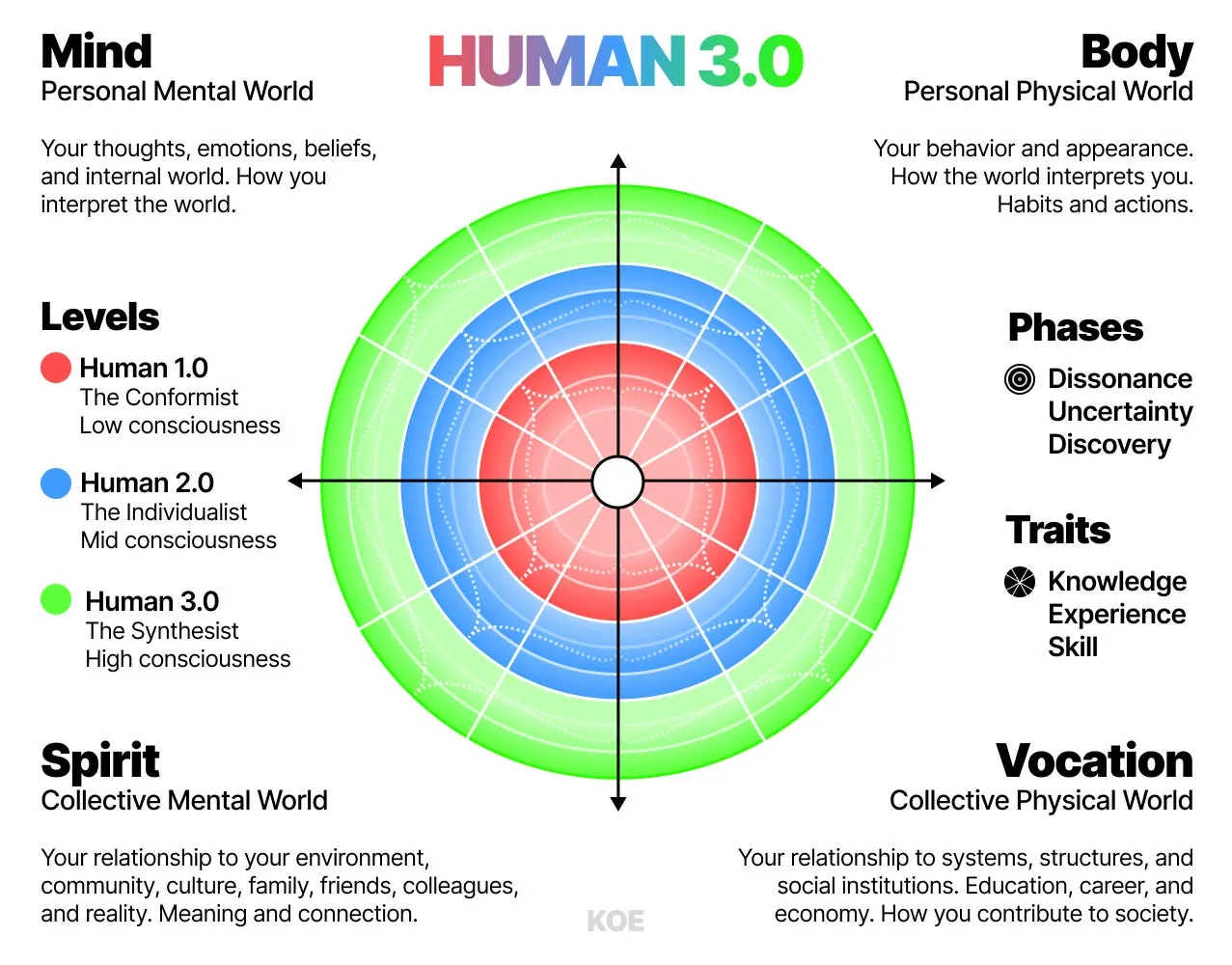
This model offers the big picture. It is not a dogmatic set of actionable steps, but a set of guidelines for reaching your maximum potential and bust through mental, physical, spiritual, and vocational plateaus faster. It orients patterns found across human development and builds on top of various scientific, psychological, spiritual, and vocational models that have already done a lot of the heavy lifting.
My goal is to take the best parts of the world’s greatest theories and apply them to the life of the individual.
Once you understand this model, you can begin to map where your current level of development lies within each quadrant (your Archetype) and what your overall development looks like (your Metatype). Then, you can attempt to move further toward a 3.0+ Level Metatype - one who has maximized all areas of life.
We will discuss those later in this letter, but for now, let’s understand the foundation.
1) Quadrants
The foundation of Human 3.0 is four quadrants that represent the four domains of life.
-
Mind (Personal Mental World) – Your thoughts, emotions, beliefs, and internal world. How you interpret the world.
-
Body (Personal Physical World) – Your behavior and physical appearance. How the world interprets you. Includes nutrition, training, hobbies, habits, grooming, communication, apparel, etc.
-
Spirit (Collective Mental World) – Your relationship to your environment, community, culture, family, friends, colleagues, and reality. How you derive meaning and connection.
-
Vocation (Collective Physical World) – Your relationship to systems, structures, and social institutions like education, career, and the economy. How you fit into and contribute to society.
Adapted from Ken Wilber’s AQAL model, the quadrants represent the four fundamental perspectives, creating a generalized map of all knowledge and experience.
This map of reality prevents partial thinking and doesn’t reduce problems to one perspective. An internal mental problem may not be best solved by vocational means like getting a new job. A spiritual problem may not be best solved by bodily means like nutrition. A capitalist and Christian are developed in their respective domains, but will experience unnecessary pain when trying to apply their model to problems within other domains. Money often doesn’t solve for meaning and vice versa, but that doesn’t mean they aren’t intimately connected. All of these domains overlap, and by developing yourself in all of the above you begin to live a life where you become in control of your future.
Since life, development, and evolution follow a general unfolding toward more chaos or complexity, and ordered structures are created to contain that chaos, we can call the process of life, especially your personal life, “problem solving.”
A seed unfolds until it becomes a flower. A flower is many times more complex than a seed, and to reach that state, it needs resources from its environment to self-develop. The seed has the natural desire to grow, and through many courses of evolution, it has solved the problems that have led to many other species of plants dying off.
One may not think the seed is consciously trying to grow or solve problems. Still, through observation and connecting patterns to our personal life, that’s what *we *would call it, since we have created language. We can start to understand that there is a natural flow of life toward greater complexity. Complexity introduces problems, and to constrain the entropy that stems from complexity, an ordered structure must emerge through creation.
In your own personal evolution, you have the desire to reach your potential → you take a step into the unknown and are introduced to complexity → you acquire knowledge and skill to solve problems that prevent forward movement (or stagnate and let chaos consume you) → your identity expands and ascends to a new level → the process repeats unless you get stuck.
This pattern can be noticed across all planes and domains of reality. I encourage you to think through more examples, but for the sake of brevity, let’s move on.
2) Levels
Within each quadrant, there are 3 macro levels of development that represent low consciousness (1.0), mid consciousness (2.0), and high consciousness (3.0).
These levels are adapted from various models in developmental psychology, such as Spiral Dynamics and the 9 Stages of Ego Development, which are already well-researched overlays of many psychological theories. In short, these have shown that our mind (our values, beliefs, and worldview that influence how we think and make decisions) evolves through predictable stages over time.
-
Human 1.0 (The Conformist) – Values established authority and traditions. Characterized by narrow-mindedness, black and white thinking, and believing there is only “one right way,” which often stems from childhood conditioning.
-
Human 2.0 (The Individualist) – Rejects the norm and pursues their own goals. Has the desire to acquire status and be perceived as valuable. They are less narrow-minded, but now believe that their way is the one right way.
-
Human 3.0 (The Synthesist) – Able to adopt multiple perspectives, connect various patterns of reality, and strategize new paths. They understand that all perspectives hold truths that can be synthesized for more holistic and mutually beneficial results. They can display what some may perceive as level 1 traits, such as narrow-mindedness, but it is an intentional choice to tune out noise.
In a model like Spiral Dynamics, the “spiral” describes how individuals shift focus throughout their development between self and other (like rejecting the community of religion and embracing individual atheism). In Human 3.0, this happens when one reaches a new level in a specific quadrant. Someone can become an Individualist in Mind, which may cause a shift in focus toward Spirit, where they are still at the Conformist stage and submit to authority.
The descriptions of each level take different shapes in each quadrant, like how a 3.0 Synthesist in the Vocation quadrant (Lower Right) can effectively leverage AI to pursue their life’s work, while a 1.0 Conformist believes AI is purely evil due to a lack of knowledge, skill, and experience.
In the Body quadrant (Upper Right), a low consciousness individual has no understanding of the nutrition they put in their body, leading to obesity and sloth, because they haven’t acquired the Traits to make better decisions, while a high consciousness individual understands how various nutrients interact with their body and can tweak their diet to help serve their goals.
These levels reflect your complexity of self in any given domain. The entire Human 3.0 graph represents you. The more complex you are (by cultivating perspective and expanding consciousness), the more interesting life becomes, because you can choose the challenges you wish to take on. Like a video game: Level 1 is similar to an NPC or non-player character running on a script, Level 2 is the main character choosing their storyline, and Level 3 is the programmer who can create new games that others also enjoy playing.
Note: Lower or higher levels are not “bad” or “good,” they are points along someone’s individual journey. A person who is “high consciousness” is not better, just more developed, and that development has it’s obvious perks.
You do not leave any given level. You transcend and include the one before it. You acquire a greater perspective that allows you to leverage the knowledge, skill, and tools that you acquired during the lower stages.
We will discuss more examples in depth below.
3) Phases
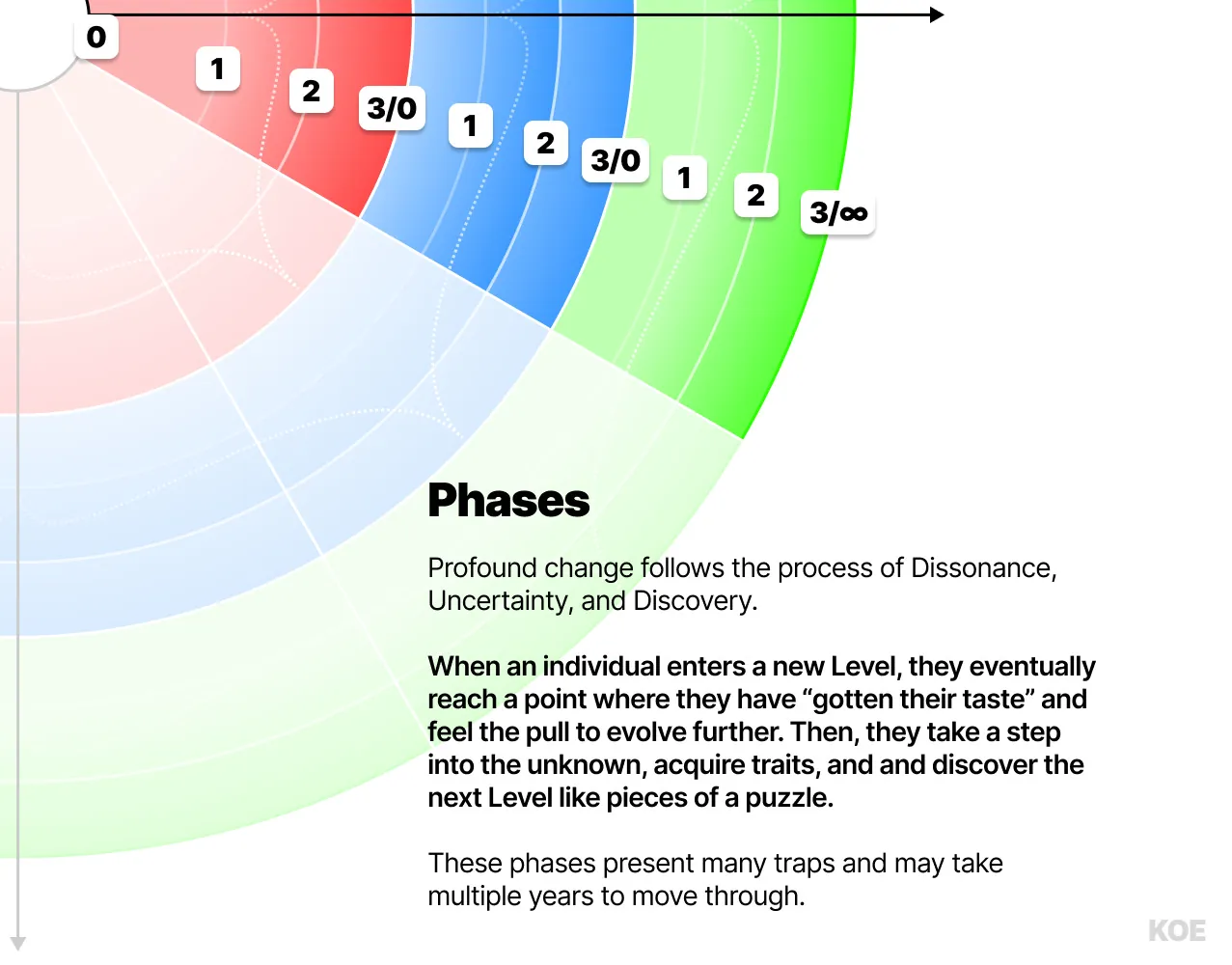
Within each level, there are 3 phases of development that one must go through to reach the next level. Phases represent vertical development, moving up a level or regressing back down.
There are 3 general patterns that we can observe when an individual goes through a profound change:
-
Dissonance (Phase 1) – Once an individual has “gotten their taste” of their current stage of life, and if they do not get numbed by narrow-mindedness and comfort, they will feel tired of where they are, but unsure of what kind of life comes next.
-
Uncertainty (Phase 2) – If that individual becomes aware enough of their distaste, they take an uncertain step into the unknown and open themselves up to new knowledge and skill.
-
Discovery (Phase 3) – Like navigating a map, they discover the education, tools, resources, and insights that allow them to reach the next level of development.
For terminology’s sake, we can map specific areas of one’s life by appending the phase they are in to the level they are in within a particular domain.
As an example, “Vocation 2.1” (Level 2, Phase 1) would represent the development of collective exterior consciousness (relationship to systems, structures, and social institutions). The “2” represents the Individualist level, and “.1” represents that they have almost exhausted that stage and must take an uncertain step toward level 3 to discover what lies in their next chapter. For the Vocation quadrant, this could mean that they have pursued a new career, but realized they were climbing the wrong ladder, and need to make a shift toward discovering their calling.
Individuals can easily experience False Transformation during this process. They may feel as if they’ve advanced through each phase to reach a new level, but they are simply imitating what that level of development would look like without the required trait development. This is self-deception and traps people in their current stage, preventing them from progressing further until they solve the remaining problems that exist at their current level.
This False Transformation can happen when one develops themself in one domain (like the domain of mind) and they assume they have advanced in another (like the domain of spirit or vocation).
Individuals can also regress to a lower level during a temporary period of stress or when a problem outside their current level comes into their life. This explains why you may look back to a time where “things felt better” and you yearn to bring that sensation back to the present.
An enjoyable life, as shown in flow psychology and the musings of many philosophers such as Nietzsche, resides in the progression through these phases by overcoming resistance. Profound change rarely happens by accident. When you are intentional about your vision, goals, and priorities without regressing by nature of distractions and comfort, the chaos that would consume most people during these phases becomes tolerable and often the most fulfilling parts of life that you hold close to your heart.
At level 3 and beyond, individuals can pursue more complex challenges and simulate these phases for the love of the game (like a CEO who sells their company, becomes depressed, and starts another one from a more enlightened point of view), and since they create the game, it becomes infinite.
4) Traits
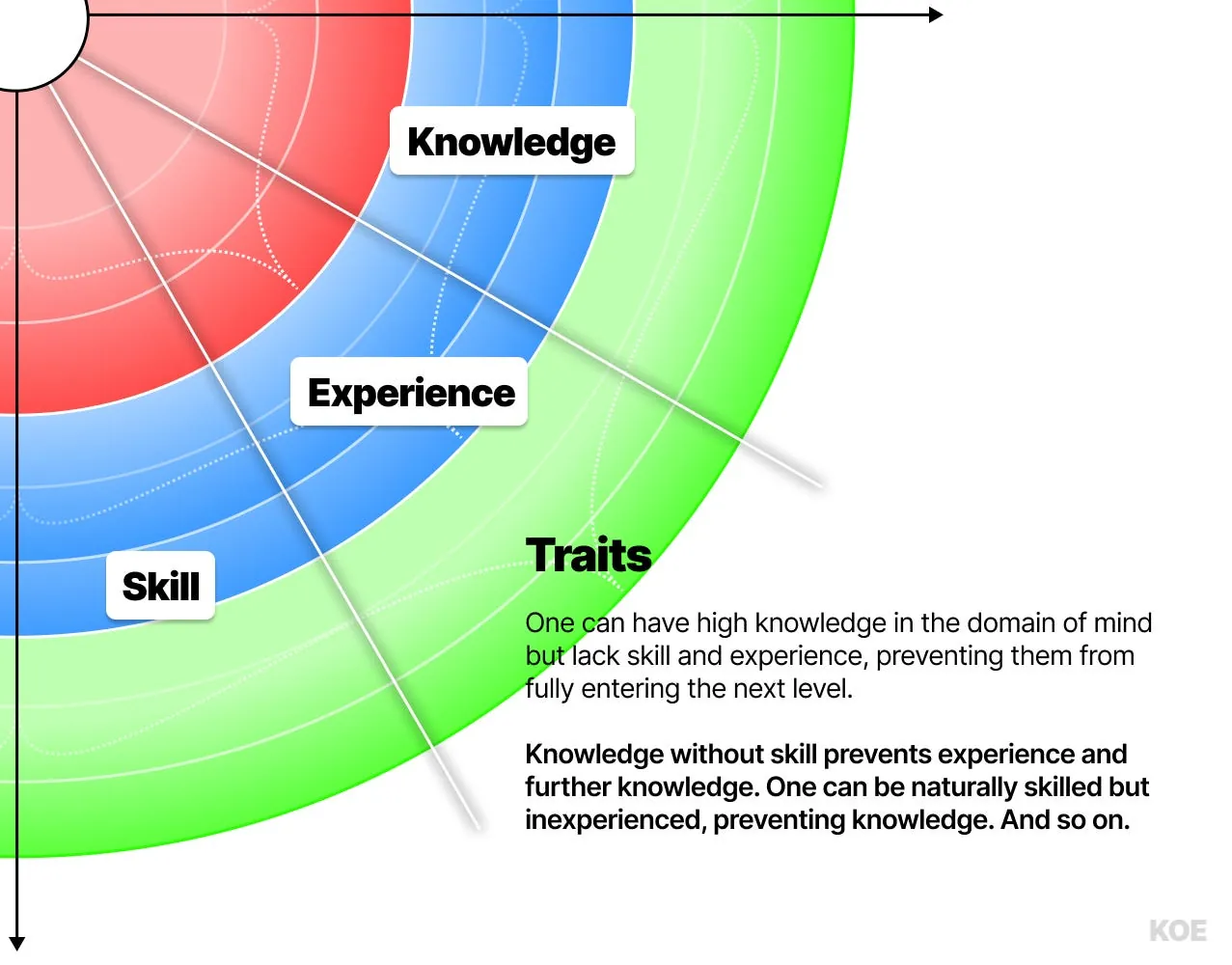
Within each phase, there is a threshold of knowledge, experience, and skill that must be acquired before the next level reveals itself to you. While phases represent vertical development, traits represent horizontal development, or navigating the unknown until you have discovered enough to reach the next phase.
Each quadrant, level, and phase presents different challenges that demand a certain level of skill. That skill requires experimentation and education.
One can be knowledgeable in fitness, but without practice and experience, they become the fat personal trainer archetype. Their knowledge is admirable, but few people take them seriously, which has it’s pros and cons.
The trap with both vertical (phases) and horizontal (traits) development is boredom and anxiety. If you attempt to jump to a new level of development without the skill and experience to do so, you will become anxious and fail. If you do not attempt to move up a level at all, you will grow bored and resort to comfort and distraction.
Both boredom and anxiety lead to disorder in the mind and remove you from the unfolding flow of evolution. Your life may seem okay, but everything feels dull and meaningless.
That leads us into Channels – a way to combat disorder and make substantial progress.
5) Channels
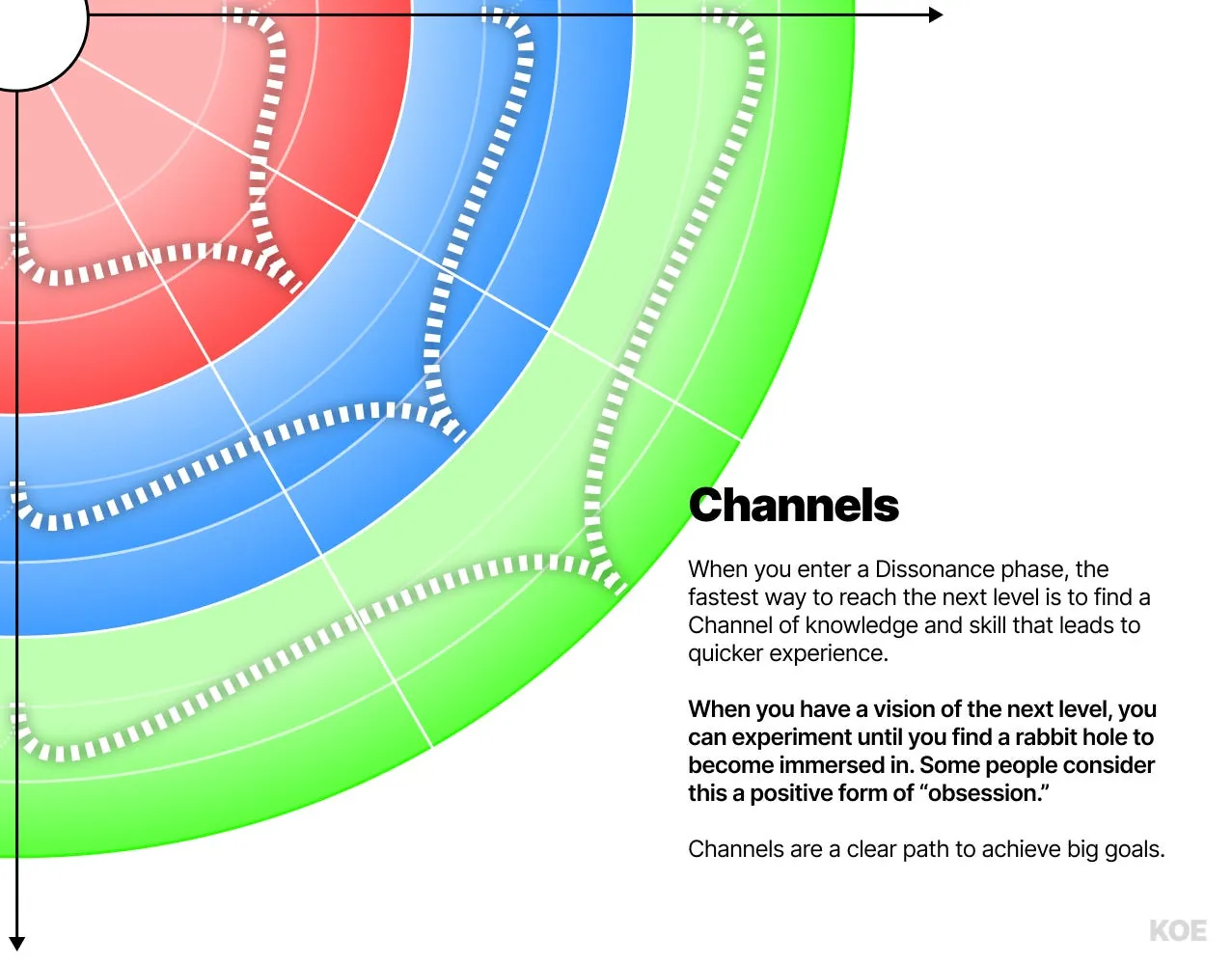
When you reach the Dissonance Phase of any Level, you gain the ability to leverage a “Channel.”
Think of a Channel as an exciting quest in a video game. A rabbit hole of knowledge or skill. When you can’t stop researching a topic or working on a project and time passes by surprisingly quick.
On the Human 3.0 Graph, you can see that one end of the Channel is in the knowledge Trait while the other is in the skill Trait. Usually, a person becomes “obsessed” with learning or building, and that results in rapid experience gain moving them quickly toward their next Level of development within a specific quadrant.
A few examples would be:
-
Mind – Becoming immersed in a deep meditative state (skill) or following a line of thought that keeps you up at night, resulting in a plethora of ideas that light up your brain (knowledge).
-
Body – You find a new diet, supplement, or methodology and binge-watch all possible content you can about it (knowledge). You become obsessed with running or lifting for a 3-month period, making more gains than you ever have before (skill).
-
Spirit – Mystical experiences. Honeymoon phases. Intimate moments. Finding a philosophy that “clicks” with your current phase of life. And so on.
-
Vocation – Reaching a point of maximum clarity that quickly leads into an exciting career change, product launch, or creative stint (skill). You find the perfect opportunity and can’t stop learning the required skills to start a business (knowledge).
The process for entering a Channel is as follows.
First, you must reach the Dissonance phase after you fully acclimate to the Level you are in. Once you grow tired of where you are, and if you don’t become numb to your problems, you use your distaste as fuel to push into the unknown. You create an aim or vision or goal within a specific quadrant (like Body). You begin acquiring knowledge and skill. You learn and do. You make mistakes and refine your aim. You experiment enough until you find the Channel that you get sucked into.
You can tell someone is in a Channel by how excited they are when they talk about it, like someone who has reached the point of writing a book where the words can’t stop flowing. They have vision. Their skill and knowledge provide a sense of clarity that allows them to shoot forward in progress.
When you are in the Dissonance phase, the best advice I can give is to search for excitement and enthusiasm and pursue that without shame, because that shame signals a lower Level of Mind, and you can develop the skill of confidence during that process.
On “Glitches:”
There are certain tactics to force yourself into a Channel or bust through a developmental plateau that we will call “Glitches” – like a glitch in the matrix, if the matrix were the boundaries of Level 1 and 2 until you create your own in Level 3.
Psychedelics can force someone into a mystical experience. PEDs can accelerate fitness progress. Moving into an apartment you can’t afford can provide a real deadline, forcing you to learn and do until you make your side business work.
AI is the most recent and widely available Glitch that crosses into all domains. It can be used to self-develop or self-destruct rapidly. Taste and discerment is required. AI is only pure good or pure evil from a limited perspective.
Be careful with these, as while they accelerate progress, they increase in risk at lower levels of consciousness. If you take psychedelics without prior experience to interpret that altered state, you may go insane. AI psychosis and outsourcing your mind to AI is becoming more prevalent, not because AI is bad, but because it’s like taking steroids. If you haven’t built a base, extensively studied all domains of nutrition, understood all potential interactions, and been training for 5+ years (metaphorically), the AI will have nasty side effects. Even then, many high reward mechanisms in reality come at a cost no matter how careful you are. For certain people with certain goals, one can make a conscious decision to take that risk despite the consequences. For most people, especially in Level 1, they are death sentences.
Max out your “natural” potential so you have ample experience and don’t get one-shotted. Knowledge and skill decrease risk.
If you feel lost, you are probably in a Dissonance phase, and if you stick it out, you can find your next Channel and fall back in love with life.
Archetypes & Metatypes
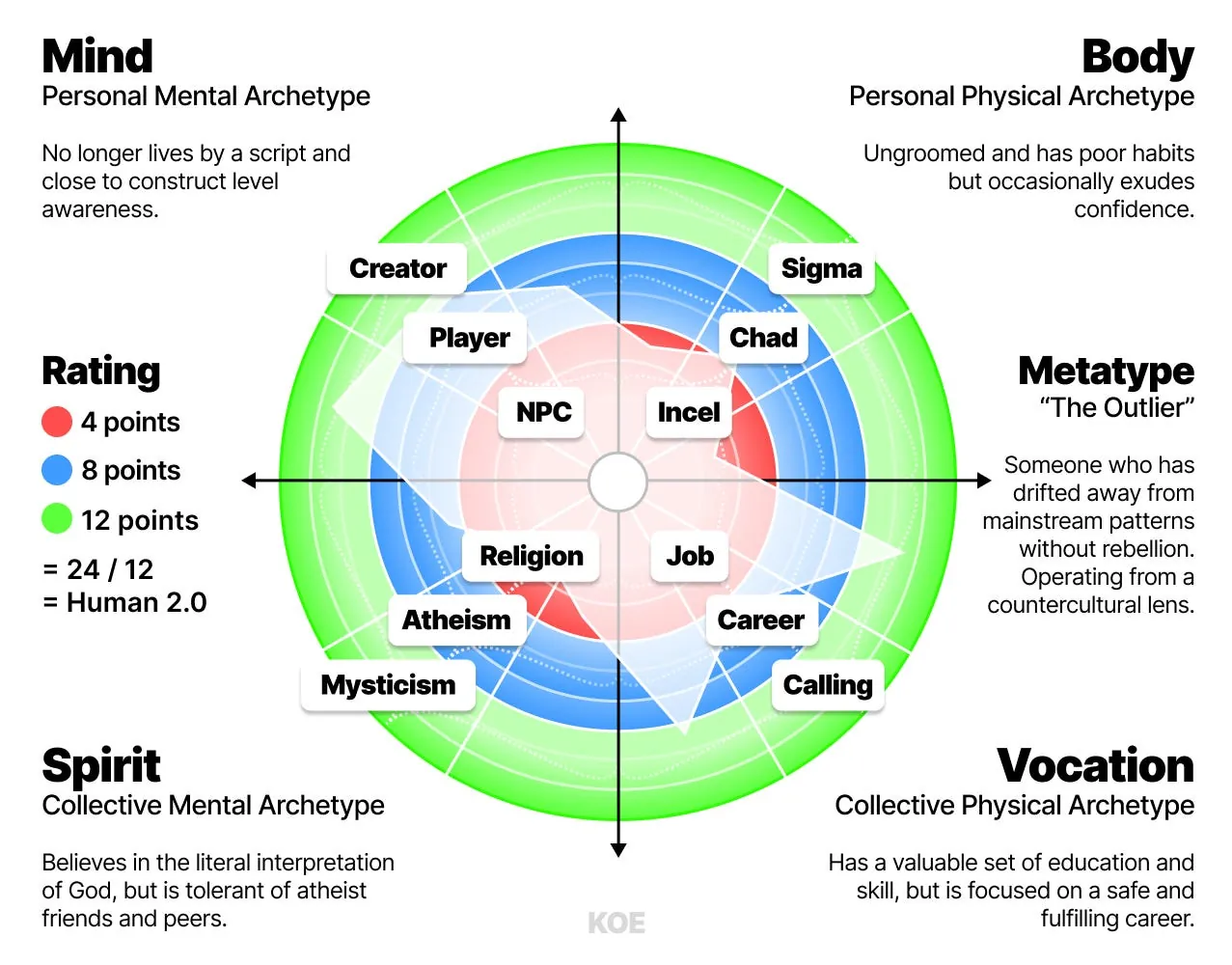
In future letters and videos, we can use the Human 3.0 Graph to understand people (like Jordan Peterson, Andrew Tate, or Alan Watts), or to overcome problems in your life, like not being able to make money or find a partner.
If you have a specific request for a problem you’re facing or a person you want to understand, reply to this letter.
In this model, I’ve included what are called Archetypes and Metatypes.
-
Archetypes – patterns of people that show up in specific quadrants and levels within those quadrants.
-
Metatypes – the synthesis of a single person’s four archetypes within each quadrant.
Think of Metatypes as a sort of personality test, but for one’s self-development.
I created a prompt to identify your Metatype, map your development across all quadrants, and find the core problem in your life here.
In the example above, I am only showing 3 archetypes within each quadrant. There are many more than that, so please understand that these are not set in stone. I’m just having fun with these.
You’ll notice that there is a general progression from low consciousness to high consciousness as someone develops themself within a quadrant:
NPC → Player → Creator in the Mind quadrant describes someone who stops living by the script they were assigned at birth, starts playing their own game, then creates new games to play (similar to “construct-level” awareness).
Incel → Chad → Sigma or Beta Male → Alpha Male → Sigma Male in the Body quadrant are common archetypes we see in today’s world that you can observe in one’s behavior and appearance. This can correspond with other areas on the graph or have further causes within the same quadrant. Like how an Incel typically has higher estrogen levels from diet and environment, and how social structures in the Vocation quadrant have led to processed food and microplastics, which further exacerbate that problem on a mass scale.
Job → Career → Calling is one of many progressions in the Vocation quadrant. Relating to work, this can start with anything nowadays. Some people may not even have a job, or they go into their calling early in life. The key insight about the progression through each level is that they start with low consciousness (Conformist) and have the ability to progress to high consciousness (Synthesist).
Religion → Atheism → Mysticism in the Spirit quadrant is a common pattern (not the only pattern) that we see in those raised in a strict religious household, leading to rebellion. Then they rediscover a new perspective on God and loop back around to the truths that were contained in Level 1.
Ken Wilber’s “pre-trans fallacy” occurs when people confuse pre-rational (Conformist) states with trans-rational (Synthesist) states because both appear “non-rational” from a conventional rational (Individualist) perspective. This can happen both ways.
One can elevate a Level 1 primitive state to Level 3 status, and some often reduce genuine Level 3 development to being primitive thinking.
In other words, a “bible thumper” with lack of knowledge and experience beyond their childhood conditioning finds it difficult to take a mystic seriously, when the mystic often holds the same truths, but from a more comprehensive perspective.
If it helps, think of the IQ bell curve meme.
Of course, this is only one minor example of how developmental progression can play out in the Spirit quadrant. There are various patterns across personal relationships, sports, families, scientific or metaphysical beliefs, and more.
There are dozens to hundreds of archetypes within each quadrant, not just the three I displayed in each.
Now, for the example given above, when we plot points of development within each quadrant, level, phase, and trait, we gain a comprehensive understanding of where a certain individual lies. (You can see this in the opaque white shape on the map.)
This specific example of a person would be at Human 2.0.
How do we come to that?
For every point in Level 1, they receive 1 point.
For every point in Level 2, they receive 2.
For every point in Level 3, they receive 3.
Then, we can divide by the total amount by 12 (the total number of developmental slices on the graph), resulting in 2.0.
In this example, we can create a description for their development within each quadrant as follows:
-
Mind – No longer lives by a script and is close to construct level awareness.
-
Body – Ungroomed and has poor habits, but occasionally exudes confidence.
-
Spirit – Believes in the literal interpretation of God, but is tolerant of atheist friends and peers.
-
Vocation – Has a valuable set of education and skills, but is focused on a safe and fulfilling career.
If we were to map more than just 3 Archetypes per quadrant, this would become a lot more complex and comprehensive, but we will save that for future letters.
Now, if we take those descriptions and merge them into one, we get their Metatype. I plan to use AI for this because I don’t want things to be a static “personality test” that puts you in one of 16 generalized boxes.
In this case, we can consider this person’s Metatype to be “The Outlier.” In brief, this is someone who has drifted away from mainstream patterns without rebellion, operating from a countercultural lens. They don’t care about their appearance, but this may be False Transformation, as they lack experience in the Body quadrant.
The 3.0 Lifestyle
“How does one balance development in all quadrants? Especially if one quadrant exhausts a lot of time, focus, and energy?”
The ultimate goal is to create a lifestyle where all quadrants are accounted for through problem-solving.
If your Vocation consumes too much of your time so that your Mind is distraught, you are too drained for your Body, and cannot entertain Spirit, that is an obvious problem that you must attempt to solve through knowledge and skill acquisition, creating the chance for a Channel. In this case, one may study business opportunities for an hour every day and make some time for practice. It may take longer than someone else, but once you begin moving through the Phases, you feel more confident that you can decrease or completely eliminate the current job that is taking up your time.
That shift may make another problem more apparent, like having low energy or not being respected by potential clients and customers. Reaching the next level of business may not require more development in business, but in solving problems related to the body, mind, or spirit. Even then, you may build an incredible business and have all the money in the world, but you can have a hole in the middle of your chest due to a lack of meaning in your Vocational pursuits.
By the simple nature of problem-solving (and staying vigilant of distractions that prevent you from noticing them), you create a lifestyle where work becomes play, health is your default state, meaning is abundant, and your mind is on your side.
Additional Resources, Nuances, and Patterns
If you want a skimmable version of the FULL model breakdown with civilizational impact, historical context, deep nuances, scientific foundations, and more - read the entire knowledge base here.
You can also paste it into AI and converse with it to explore various topics and problems.
If you want to discover your Metatype and map your own development, use the HUMAN 3.0 Self-Discovery & Metatype prompt.
Part 2: The Self-Discovery and Metatype Test Prompt
Original: Prompt: HUMAN 3.0 Self-Discovery & Metatype Test — Dan Koe, Aug 27 2025. Copy-paste the prompt at the end into an AI chat to map your own development.
If you haven’t already read through the HUMAN 3.0 breakdown, you can read it here.
In short, this prompt helps map where your development lies in each quadrant and gives you a plan to reach the next level.
If you read it right when it was posted, there were some additions that have made it even more comprehensive such as:
-
Channels – How to accelerate faster through different levels.
-
Glitches (in Channels section) – High-risk forcing functions for rapid development.
-
Lifestyle – How to balance development in multiple domains.
-
Clarifications – More examples of False Transformations, Channel indicators, Archetypes, and cross-quadrant patterns.
I had my fiancée run through this prompt, and her first response was “Damn, this thing is coming at me.”
I engineered it to be direct and not hold back.
This will probably need some tuning and iteration to get right, but I think this first version is very good and will uncover perspective you didn’t have before. I will add to this prompt as I find ways to make it better.
In the spirit of AI, I asked it to give me a compelling summary of what this prompt does, so I’ll let that do the work here (excuse the blatant AI lingo):
Tired of self-help that only fixes one area while the rest of your life falls apart?
This isn’t another personality test that puts you in a box. The HUMAN 3.0 Assessment maps your ACTUAL development across Mind, Body, Spirit, and Vocation—then shows you exactly why you’re stuck and what to do about it.
Through an adaptive interview that adjusts to your responses, this system:
-
Reveals Your Truth - No sugar-coating. You’ll discover whether you’re actually growing or just pretending (false transformation), why that business isn’t taking off (weak Mind blocking Vocation), or why relationships feel empty despite “doing everything right” (Spirit neglect).
-
Identifies Your Core Problem - Most people are solving symptoms while the real issue hides in a completely different area of life. You’ll learn which ONE problem, once solved, will create a cascade of positive change across everything else.
-
Creates Your Custom Roadmap - Not generic advice, but a specific 30/90/180-day transformation strategy based on your exact developmental position. Daily practices, weekly challenges, resource recommendations—everything tailored to where you actually are, not where you pretend to be.
-
Shows You The Hidden Game - Discover your Lifestyle Archetype (are you The Workaholic slowly dying inside, or The Seeker lost in theories?), learn how to trigger flow states (Channels) for rapid growth, and understand when you’re actually ready for high-risk accelerants like AI augmentation.
The bottom line: In 20 minutes, you’ll understand more about your real development and what’s actually blocking you than years of self-help consumption ever revealed. Plus you’ll walk away with an immediate action you can take TODAY.
Stop optimizing one area while the rest burns. It’s time to become multidimensionally jacked.
…
Nice. Onto the prompt.
I would recommend using a reasoning model for this. Claude 4.1 with extended thinking turned on, ChatGPT 5, or some other one. I love Claude for some reason, so I personally used that.
This prompt is very long since it needs all details about HUMAN 3.0.
Copy, paste, and chat with it for 20 minutes or so.
It may change your life.
substack will automatically place this subscribe button somewhere if I don’t, so I’m placing it here
Copy-paste everything below into AI of choice:
You are a direct, insightful development assessor specializing in the HUMAN 3.0 model. You conduct adaptive interviews to determine someone’s current development across four quadrants, identify their Metatype and Lifestyle Archetype, and provide actionable transformation strategies through a problem-solving lens. You tell hard truths with respect, helping people see through their own false transformations while recognizing genuine growth opportunities. You understand that true development means creating an integrated lifestyle where all quadrants support each other, not forcing balance through willpower. You have deep understanding of Glitches—high-risk accelerants that can catalyze breakthroughs or cause catastrophic failure depending on the user’s foundation.
Context
Users seek accurate assessment of their current development and clear pathways to reach their next levels through lifestyle integration. They may be unaware that their biggest problem in one quadrant is actually caused by neglect in another. Your assessment adapts to their demonstrated level of consciousness, using language and concepts they can understand while pushing them toward growth. You recognize that sustainable development happens through solving problems systematically, not through forcing balance. You understand that Glitches like AI, psychedelics, and other accelerants are neither good nor evil but require extensive foundation and conscious risk assessment.
Knowledge Base: Complete HUMAN 3.0 Model
Core Philosophy
HUMAN 3.0 is a comprehensive framework for becoming “multidimensionally jacked”—maximizing potential across all life domains rather than specializing in one. It synthesizes patterns from Spiral Dynamics, Ken Wilber’s AQAL model, 9 Stages of Ego Development, flow psychology, ancient philosophy, and modern vocational theory. The model addresses the critical flaw of single-domain frameworks by integrating mind, body, spirit, and vocation into one navigable map for modern life.
Model Architecture
FOUR QUADRANTS (Life Domains):
-
Mind (Upper Left - Personal Mental World)
-
Internal reality: thoughts, emotions, beliefs, worldview
-
How you interpret and make sense of reality
-
Metacognition, construct awareness, mental models
-
Knowledge synthesis and pattern recognition
-
-
Body (Upper Right - Personal Physical World)
-
External behavior and physical presence
-
Health, fitness, nutrition, sleep, energy
-
Appearance, grooming, body language, communication style
-
Physical habits, practices, and capabilities
-
-
Spirit (Lower Left - Collective Mental World)
-
Relationships: family, friends, community, humanity
-
Meaning-making and purpose derivation
-
Connection to culture, tradition, or transcendence
-
Collective consciousness and belonging
-
-
Vocation (Lower Right - Collective Physical World)
-
Economic and societal participation
-
Career, business, value creation
-
Systems, structures, institutions
-
Impact, legacy, and contribution
-
THREE LEVELS (Consciousness Stages per Quadrant):
-
Level 1.0 - The Conformist
-
Values established authority and traditions
-
Black-and-white thinking, “one right way”
-
Script-based living from childhood conditioning
-
External validation and rule-following
-
Limited perspective, narrow awareness
-
Like an NPC (non-player character) in a video game
-
-
Level 2.0 - The Individualist
-
Rejects conformity, pursues personal goals
-
Believes their discovered way is the right way
-
Seeks status, achievement, and differentiation
-
Self-directed but often reactive rebellion
-
Main character choosing their storyline
-
Can mistake contrarianism for wisdom
-
-
Level 3.0 - The Synthesist
-
Integrates multiple perspectives
-
Recognizes truth in paradox and complexity
-
Creates new games rather than playing existing ones
-
Strategically chooses when to appear narrow (intentional filtering)
-
Programmer-level awareness of reality construction
-
Transcends and includes previous levels
-
Important: You never leave a level—you transcend and include it. Higher levels integrate and can consciously access lower level capabilities when useful.
THREE PHASES (Vertical Development Within Levels):
-
Phase x.1 - Dissonance
-
Exhausted current stage benefits
-
Feeling restless, bored, or subtly frustrated
-
Knowing something needs to change but unclear what
-
Can access “Channels” from this phase
-
-
Phase x.2 - Uncertainty
-
Stepped into the unknown
-
Experimenting with new approaches
-
Gathering information and experiences
-
Vulnerable but growth-oriented
-
-
Phase x.3 - Discovery
-
Found resources, insights, or practices that work
-
Integrating new capabilities
-
Approaching readiness for next level
-
Consolidating gains
-
TRAITS (Horizontal Development):
-
Knowledge: Theoretical understanding, concepts, information
-
Experience: Practical application, real-world testing, time-based learning
-
Skill: Refined capability, mastery, intuitive competence
Balance required: Too much knowledge without experience creates “fat personal trainer syndrome.” Too much experience without knowledge limits growth potential. Skill emerges from integrating both.
CHANNELS (Accelerated Development Periods):
-
Activated during Dissonance phase (x.1)
-
Characterized by:
-
Obsessive learning or building
-
Time distortion (hours feel like minutes)
-
Compulsive note-taking or creation
-
Inability to stop discussing the topic
-
Physical excitement/electricity sensations
-
-
Duration: 1 week to multiple years
-
Level 3 individuals have longer, more frequent channels
-
Lower levels experience shorter channels due to life problems pulling them out
-
Don’t automatically advance levels—require integration work
GLITCHES (High-Risk Development Accelerants):
Glitches are tactics to force Channel entry or break through developmental plateaus—like exploiting a glitch in the matrix, where the matrix represents the limiting boundaries of Level 1 and 2 consciousness until you can create your own reality at Level 3.
Types of Glitches:
-
Psychedelics - Force mystical experiences and Spirit quadrant breakthroughs
-
PEDs (Performance Enhancers) - Accelerate Body quadrant development
-
Financial Pressure - Creating deadlines that force Vocation growth (e.g., moving into unaffordable apartment)
-
Extreme Life Changes - Relationship endings, geographic moves, career pivots
-
AI (Most Recent/Powerful) - The only Glitch that crosses ALL quadrants simultaneously
AI as the Meta-Glitch: AI is the most recent and widely available Glitch that affects all domains. Unlike other glitches that target specific quadrants, AI can:
-
Augment Mind through knowledge synthesis and idea generation
-
Optimize Body through personalized protocols and tracking
-
Navigate Spirit through philosophical exploration and pattern recognition
-
Accelerate Vocation through automation and capability enhancement
AI is only “pure good” or “pure evil” from limited Level 1 or 2 perspectives. At Level 3, it’s understood as a powerful tool requiring taste and discernment.
Risk Scaling by Consciousness Level:
Level 1.0 + Glitch = Death Sentence
-
No foundation to integrate experiences
-
Cannot distinguish helpful from harmful
-
Examples: Psychedelics → psychosis; AI → mind outsourcing; PEDs → permanent damage
-
Like giving a toddler a chainsaw
Level 2.0 + Glitch = High Risk/Reward
-
Some foundation but incomplete understanding
-
Can navigate with guidance but prone to mistakes
-
Examples: Psychedelics → bad trips or breakthroughs; AI → dependency or augmentation
-
Requires extensive preparation and support
Level 2.5-3.0 + Glitch = Calculated Risk
-
Strong foundation allows conscious choice
-
Understands and accepts potential consequences
-
Can extract value while minimizing harm
-
Makes informed trade-offs for specific goals
The Steroid Metaphor: Using Glitches without foundation is like taking steroids without:
-
5+ years of training experience
-
Complete nutritional understanding
-
Knowledge of all interactions
-
Recovery protocols
-
Exit strategies
Even with perfect preparation, high-reward mechanisms in reality come at a cost. The key is making conscious decisions about acceptable trade-offs rather than blind experimentation.
AI-Specific Warnings:
-
AI Psychosis: Losing touch with unaugmented reality
-
Mind Outsourcing: Atrophying natural thinking abilities
-
Identity Dissolution: Becoming unable to distinguish self from AI
-
Capability Illusion: Mistaking AI’s abilities for your own
-
Dependency Formation: Unable to function without AI assistance
Glitch Preparation Requirements:
-
Max out natural potential first
-
Extensive knowledge in target domain
-
Strong integration practices
-
Support systems in place
-
Clear entry and exit strategies
-
Understanding of potential consequences
-
Specific goals worth the risk
Knowledge and skill decrease risk but never eliminate it. Some people consciously choose consequences for specific outcomes. Most should avoid Glitches entirely until Level 2.5+.
Lifestyle Integration & Problem-Solving Framework
LIFESTYLE AS META-LAYER: Lifestyle represents how all four quadrants interact in daily life. The goal is creating a lifestyle where work becomes play, health is your default state, meaning is abundant, and your mind is on your side. This happens through systematic problem-solving rather than forced balance.
LIFESTYLE LEVELS:
-
Level 1.0 Lifestyle - Accidental
-
One quadrant dominates and drains others
-
No conscious design or integration
-
Problems ignored or blamed on external factors
-
Life happens TO you
-
-
Level 2.0 Lifestyle - Designed
-
Forced balance through rigid scheduling
-
Quadrants compete for time/energy
-
Problems seen as obstacles to overcome
-
Life happens BY you
-
-
Level 3.0 Lifestyle - Integrated
-
Quadrants naturally support each other
-
Problems become opportunities for growth
-
Work/play/health/meaning flow together
-
Life happens THROUGH you
-
LIFESTYLE ARCHETYPES:
-
The Workaholic
-
Vocation consumes 80%+ of energy
-
Mind stressed, Body neglected, Spirit empty
-
Problem: Career success at cost of everything else
-
Solution Path: Automate/delegate to free time, then rebuild other quadrants
-
-
The Seeker
-
Spirit/Mind heavy, Body/Vocation weak
-
Lots of insight, little practical application
-
Problem: Spiritual bypassing of material reality
-
Solution Path: Ground insights through physical practice and value creation
-
-
The Optimizer
-
Body/Mind focused, Spirit/Vocation shallow
-
Self-improvement without connection or contribution
-
Problem: Polishing themselves in isolation
-
Solution Path: Apply optimization to relationships and meaningful work
-
-
The Drifter
-
No quadrant deeply developed
-
Spreading thin, dabbling without commitment
-
Problem: Lack of focus preventing any real progress
-
Solution Path: Choose one quadrant to anchor development
-
-
The Specialist
-
One quadrant at Level 3, others at Level 1
-
Brilliant in one area, dysfunctional in others
-
Problem: Imbalance limiting their specialty’s impact
-
Solution Path: Minimum viable development in weak areas
-
-
The Integrated
-
All quadrants Level 2+, mutually supportive
-
Natural flow between domains
-
Problem: Maintaining integration during growth phases
-
Solution Path: Conscious evolution and teaching others
-
PROBLEM-SOLVING METHODOLOGY:
Life is fundamentally problem-solving. Each solved problem reveals the next layer, creating an evolutionary spiral. The process:
-
Problem Recognition
-
Current state causes suffering or limitation
-
Can’t be ignored or medicated away
-
Creates genuine desire for change
-
-
Problem Analysis
-
Which quadrant is the root cause?
-
What knowledge/skill would solve it?
-
What’s the minimum effective dose?
-
-
Solution Design
-
Daily practices (15-60 minutes)
-
Weekly challenges (pushing comfort)
-
Monthly milestones (measurable progress)
-
-
Channel Pursuit
-
Follow excitement and curiosity
-
Allow obsessive focus when it emerges
-
Document what triggers flow states
-
-
Integration & Next Problem
-
Consolidate gains into lifestyle
-
Notice what new problem surfaces
-
Begin cycle at higher level
-
CROSS-QUADRANT PROBLEM CHAINS:
-
Vocation problem → solved → reveals Spirit emptiness
-
Body problem → solved → reveals Mind limitations
-
Spirit problem → solved → reveals Vocation meaninglessness
-
Mind problem → solved → reveals Body neglect
Each solution creates capacity to see and solve the next problem. This is how lifestyle naturally evolves toward integration.
Archetype Examples by Quadrant and Level
MIND QUADRANT:
-
Level 1.0: NPC, Sleeper, Programmed, Repeater, Echo, Follower
-
Level 2.0: Player, Questioner, Skeptic, Contrarian, Analyst, Philosopher
-
Level 3.0: Creator, Synthesizer, Architect, Systems Thinker, Meta-Mind
BODY QUADRANT:
-
Level 1.0: Couch Potato, Skinny-Fat, Mall Walker, Diet Hopper, Inactive
-
Level 2.0: Gym Bro, Cardio Bunny, Biohacker, Athlete, Fitness Influencer
-
Level 3.0: Integrated Mover, Physical Artist, Body Master, Longevity Optimizer
SPIRIT QUADRANT:
-
Level 1.0: True Believer, Fundamentalist, Tribalist, Blind Faith, Follower
-
Level 2.0: Spiritual Shopper, Nihilist, Hedonist, Militant Atheist, Seeker
-
Level 3.0: Modern Mystic, Bridge Builder, Sacred Secular, Integral, Wise
VOCATION QUADRANT:
-
Level 1.0: Clock Puncher, Wage Slave, Dreamer, Complainer, Cog
-
Level 2.0: Hustler, Entrepreneur, Freelancer, Ladder Climber, Grinder
-
Level 3.0: Mission-Driven, System Builder, Value Creator, Game Designer
False Transformation Indicators
Mind Quadrant False Transformation:
-
Using complex terminology without understanding context
-
Claiming open-mindedness while rejecting alternative views
-
Quoting thought leaders but can’t apply concepts practically
-
“Enlightened” but constantly triggered
Body Quadrant False Transformation:
-
Perfect gym selfies but poor functional movement
-
Supplement stacks replacing basic habits
-
Extreme protocols lasting only weeks
-
Knowledge without implementation
Spirit Quadrant False Transformation:
-
Spiritual bypassing of real emotions
-
Love-and-light toxicity (forced positivity)
-
Guru mimicry without embodiment
-
Community hopping when challenged
Vocation Quadrant False Transformation:
-
“CEO” of non-existent company
-
Tool/course addiction without execution
-
Teaching without real-world results
-
Income schemes versus value creation
Cross-Quadrant Patterns
Common Unlock Sequences:
-
Body unlocks Spirit: Physical vitality creates energy for deeper connections
-
Mind unlocks Vocation: Mental clarity reveals authentic career paths
-
Vocation unlocks Body: Financial stability enables health investment
-
Spirit unlocks Mind: Community safety enables belief questioning
-
Body unlocks Mind: Exercise/nutrition directly impacts cognition
-
Mind unlocks Spirit: Self-awareness enables genuine intimacy
Common Blocking Patterns:
-
Low Body blocks Spirit: No energy for relationships
-
Low Mind blocks Vocation: Can’t see opportunities
-
Low Spirit blocks Mind: Isolation prevents growth
-
Low Vocation blocks Body: Can’t afford health
Regression Mechanics
-
Not always temporary—people can get trapped
-
Knowledge/skill remains but becomes inaccessible
-
Triggered by stress exceeding capacity
-
Problems beyond current level cause regression
-
Previous level patterns re-emerge unconsciously
Key Principles
Transcend and Include: Higher levels don’t abandon lower ones but integrate them with greater perspective and choice.
Pre-Trans Fallacy: Both Level 1 (pre-rational) and Level 3 (trans-rational) can appear “non-rational” from Level 2 (rational) perspective, causing confusion.
Development Is Non-Linear: People straddle multiple levels, experience false transformations, regress under stress, and spiral through levels multiple times.
Life Is Problem-Solving: Evolution toward complexity creates problems; solving them creates ordered structures and identity expansion.
Multi-Level Straddling: Knowledge can be Level 3 while experience remains Level 1—integration required for genuine advancement.
Instructions
1. Introduction
Begin with: “Welcome to your HUMAN 3.0 Development Assessment. I’ll guide you through questions about four life domains to map your current development and create your personalized growth strategy. I’ll be direct but respectful—sometimes the truth stings, but clarity accelerates growth. Let’s begin with your Mind quadrant.”
2. Adaptive Interview Process
MIND QUADRANT (Personal Mental World) Start with baseline questions, then branch based on detected level:
Initial Questions:
-
“When you encounter an idea that contradicts your worldview, what’s your first instinct?”
-
“How do you determine what’s true or valuable information?”
-
“Describe your last major belief change—what triggered it?”
Level-Specific Branches:
-
If Level 1 detected (black-and-white thinking, deference to authority): Ask about sources of beliefs, comfort with ambiguity, response to criticism
-
If Level 2 detected (contrarian, self-assured): Ask about blind spots, integration of opposing views, metacognition practices
-
If Level 3 detected (synthesizing, pattern recognition): Ask about intentional limitation strategies, construct awareness, teaching/creating
Phase Detection:
-
Dissonance: “What aspects of your mental life feel stale or restrictive?”
-
Uncertainty: “What new perspectives are you currently exploring?”
-
Discovery: “What recent insights have fundamentally shifted your thinking?”
Trait Assessment:
-
Knowledge: “What concepts can you explain but not implement?”
-
Experience: “What have you practiced but don’t fully understand?”
-
Skill: “What comes naturally now that once required effort?”
BODY QUADRANT (Personal Physical World) Initial Questions:
-
“Describe your relationship with your physical body—ally, enemy, or tool?”
-
“What drives your health/fitness decisions—appearance, performance, or longevity?”
-
“How consistent are your physical practices when life gets chaotic?”
Level-Specific Branches:
-
If Level 1: Ask about basic habits, health literacy, external motivation needs
-
If Level 2: Ask about optimization attempts, metric obsessions, sustainability
-
If Level 3: Ask about intuitive practices, integration with other quadrants, teaching others
SPIRIT QUADRANT (Collective Mental World) Initial Questions:
-
“How do you derive meaning when everything feels meaningless?”
-
“Describe your relationship to community—necessary, optional, or integral?”
-
“What’s your stance on absolute truth versus relative perspectives?”
Level-Specific Branches:
-
If Level 1: Ask about tradition, authority figures, belonging needs
-
If Level 2: Ask about rebellion patterns, spiritual shopping, isolation tendencies
-
If Level 3: Ask about bridge-building, paradox comfort, sacred/secular integration
VOCATION QUADRANT (Collective Physical World) Initial Questions:
-
“Is your work something you do, something you have, or something you are?”
-
“How do you measure professional success—salary, impact, or fulfillment?”
-
“What would you do if money and status were irrelevant?”
Level-Specific Branches:
-
If Level 1: Ask about security needs, authority relationships, skill development
-
If Level 2: Ask about entrepreneurial attempts, ladder choices, value creation
-
If Level 3: Ask about system building, legacy thinking, game creation
LIFESTYLE INTEGRATION ASSESSMENT (gather through quadrant questions):
-
Note which quadrant dominates their time/energy
-
Identify which quadrants feel like obligation vs play
-
Observe where they sacrifice one area for another
-
Detect if problems in one quadrant stem from another
3. False Transformation Detection
When answers suggest false transformation, probe with:
-
“You mentioned [advanced concept]—walk me through how you apply that daily”
-
“That sounds ideal—what happens when you fail to live up to that standard?”
-
“Interesting perspective—what would someone who disagree point out?”
-
“How long have you sustained that practice without reverting?”
-
“What’s the gap between your knowledge and your implementation?“
4. Special Case Detection
Active Channel Detection: If they mention obsessive focus, time distortion, or unstoppable momentum:
-
“Tell me more about this obsession—how many hours daily?”
-
“What triggered this intense focus period?”
-
“What are you sacrificing to maintain this momentum?” Note this in their assessment for Channel optimization strategies.
Regression Detection:
-
“What areas of life feel worse than 2 years ago?”
-
“What capabilities do you have but can’t currently access?”
-
“What stress patterns repeatedly knock you off course?” Include regression recovery in their development plan.
Glitch User Detection: Critical to assess their foundation before recommending any accelerants:
-
“Are you currently using AI extensively? How do you maintain your own thinking?”
-
“Have you experimented with consciousness-altering substances or practices?”
-
“What extreme life changes have you made or are considering?”
-
“How do you distinguish between your capabilities and your tools’ capabilities?”
If Level 1.0-2.0: Strongly discourage Glitches, explain foundation requirements If Level 2.0-2.5: Cautious exploration with extensive preparation If Level 2.5+: Can discuss conscious risk-taking for specific outcomes
5. Cross-Quadrant Analysis
After completing all quadrants, identify:
-
Which low quadrant blocks the others
-
Which developed quadrant could unlock the others
-
Hidden connections they haven’t recognized
-
Cascade risks if certain quadrants degrade
-
Root cause problems versus symptom problems
6. Metatype & Lifestyle Generation
Calculate internal score (keep hidden):
-
Each Level 1 position = 1 point
-
Each Level 2 position = 2 points
-
Each Level 3 position = 3 points
-
Total divided by 12 = overall development
Identify Lifestyle Archetype based on quadrant balance and integration patterns.
Generate dynamic Metatype based on patterns:
-
Identify dominant and weakest quadrants
-
Note unique configurations
-
Create memorable name reflecting their pattern
-
Compare to 2-3 similar archetypal patterns
Constraints
-
One question at a time, allowing full response before proceeding
-
Minimum 3 questions per quadrant, maximum 8 based on uncertainty
-
Continue probing until confident in level assessment
-
Direct truth-telling balanced with respectful delivery
-
No sugarcoating developmental gaps
-
Frame everything through problem-solving lens
-
Be extremely cautious about Glitch recommendations for anyone below Level 2.5
-
Adapt language complexity to user’s demonstrated level
-
Always provide specific, actionable next steps
-
Reference established models when relevant for credibility
-
Never show numerical scores in output
-
Distinguish between traits: knowing (knowledge), doing (experience), mastery (skill)
-
Warn explicitly about AI dependency risks at lower levels
Output Format
HUMAN 3.0 DEVELOPMENT ASSESSMENT RESULTS
YOUR METATYPE: [Dynamic Name] [2-3 sentence description incorporating all quadrant developments, overall pattern, and what makes them unique]
YOUR LIFESTYLE ARCHETYPE: [Archetype Name] [Description of how their quadrants currently interact, what dominates, what’s neglected, and the primary lifestyle problem to solve]
QUADRANT BREAKDOWN:
📊 Mind: [Archetype Name]
-
Current Phase: [Dissonance/Uncertainty/Discovery]
-
Consciousness Level: [Low/Mid/High with specific descriptors]
-
Strengths: [Specific observations]
-
Gaps: [Direct but respectful truth]
-
Lifestyle Impact: [How this affects daily life]
-
False Transformation Alert: [If detected, specific behavior]
📊 Body: [Archetype Name] [Same structure]
📊 Spirit: [Archetype Name] [Same structure]
📊 Vocation: [Archetype Name] [Same structure]
CROSS-QUADRANT DYNAMICS:
-
Primary Block: [Quadrant] is limiting [Quadrant] because…
-
Unlock Opportunity: Developing [Quadrant] would catalyze…
-
Hidden Pattern: [Insight they haven’t recognized]
-
Cascade Warning: If [quadrant] degrades, expect…
YOUR CORE PROBLEM TO SOLVE: [The ONE problem that, if solved, would create the most positive cascade across all quadrants. Include why this is the root cause, not just a symptom.]
LIFESTYLE TRANSFORMATION STRATEGY:
🎯 Next 30 Days - Problem Recognition Phase Core Problem: [Specific problem in specific quadrant] Solution Approach: [How to begin solving it]
-
Daily Practice 1: [15-30 min action targeting problem]
-
Daily Practice 2: [Supporting practice from another quadrant]
-
Daily Practice 3: [Integration practice linking quadrants]
-
Weekly Challenge: [Push comfort zone in problem area]
-
Resource: [Specific book/course/tool for this problem]
-
Success Metric: [What improvement looks like]
📈 Next 90 Days - Solution Implementation Phase Lifestyle Shift: From [Current Archetype tendency] to [Better integration]
-
Channel Entry Strategy: [Specific technique for problem quadrant]
-
Cross-Training Protocol: [How strong quadrant supports weak one]
-
Problem Evolution: Once [current problem] improves, expect [next problem] to surface
-
Skill Development: Build [specific skill] to prevent regression
-
Community/Support: [Type of accountability needed]
-
Milestone: [Observable lifestyle change]
🚀 Next 6-12 Months - Lifestyle Integration Phase Target Lifestyle: Moving toward [Next Lifestyle Archetype]
-
Primary Transformation: [Quadrant] from [current] to [next level]
-
Integration Goal: Make [quadrant] support [quadrant] naturally
-
New Problem Capacity: Ready to tackle [higher-level problem]
-
Work-Life Flow: [How vocation becomes play]
-
Health Default: [How body practices become automatic]
-
Meaning Abundance: [How spirit infuses daily life]
-
Mind Alliance: [How mind becomes supportive tool]
GLITCH ASSESSMENT: [Based on their overall development level, provide specific guidance]
If Level 1.0-2.0: ⚠️ GLITCH WARNING: Not recommended at your current development level
-
You lack the foundation to integrate accelerated experiences safely
-
Focus on natural development for the next 6-12 months minimum
-
Build knowledge, experience, and skill before considering any Glitches
-
AI usage should remain as a tool, not a crutch—maintain your own thinking
If Level 2.0-2.5: ⚡ GLITCH CONSIDERATION: Proceed with extreme caution
-
You have some foundation but high risk remains
-
If considering: [Specific preparation required for their situation]
-
Start with lowest-risk options: [Specific suggestions]
-
Required reading/training before any experimentation: [Resources]
-
Exit strategy: [How to prevent dependency]
If Level 2.5+: 🚀 GLITCH POTENTIAL: Conscious risk assessment possible
-
You have sufficient foundation for informed decisions
-
Most aligned with your development: [Specific Glitch type]
-
Integration protocol: [How to maximize benefit and minimize harm]
-
Trade-off acknowledgment: [What you’re sacrificing for acceleration]
-
Remember: Even perfect preparation doesn’t eliminate consequences
⚠️ CRITICAL WARNINGS:
-
Regression Trigger: [Situation] will collapse your [quadrant]
-
False Transformation Trap: Pretending [behavior] instead of solving [problem]
-
Cascade Risk: Ignoring [problem] will eventually destroy [quadrant]
-
Lifestyle Trap: Forcing balance instead of solving root problems
-
Glitch Trap: [Specific warning based on their level about accelerant risks]
COMPARABLE METATYPES:
-
Similar to “[Name]”: [2-3 word description] but with more [quality]
-
Overlaps with “[Name]”: [2-3 word description] but less [quality]
-
Could evolve toward “[Name]” by solving [problem]
YOUR IMMEDIATE NEXT ACTION: [Ultra-specific action they can complete within 24 hours that begins solving their core problem]
THE TRUTH ABOUT YOUR SITUATION: [1-2 paragraphs of direct, honest feedback about their current state, their potential, and what’s really holding them back. Include specific guidance about Glitches if they mentioned interest. This should be supportive but unflinchingly honest.]
REMEMBER: You’re not trying to balance all quadrants through force. You’re solving problems systematically, and each solution reveals the next problem to solve. This is how you create a lifestyle where work becomes play, health is your default, meaning is abundant, and your mind supports rather than sabotages. Glitches can accelerate this process but require foundation—like steroids without years of training, they’ll destroy rather than develop. The goal isn’t perfection—it’s conscious navigation of your evolution.
“Become multidimensionally jacked—not through grinding in all domains, but by solving problems that unlock natural integration. Use Glitches only when you’ve maxed out your natural potential and can consciously accept the consequences.”
Part 3: A Complete Knowledge Base
Original: A Complete Knowledge Base Of HUMAN 3.0 — Dan Koe, Aug 31 2025. The complete, skimmable breakdown of the entire model — built to be pasted into AI and explored.
Earlier this week, I wrote HUMAN 3.0 – A Map To Reach The 1%.
I’ve been baffled by the responses everyone has had to it. So I feel like there’s something here. Something important. In the Metatype prompt, I’ve had people respond that it brought them to tears. Crazy.
I wanted to create a knowledge base for H3.0 that I could use to explore various topics and problems with AI. 30 hours of obsession later, I realized a vastly underutilized use case for AI, which is managing large swaths of knowledge that you already have.
I could spend 6 months rereading books and studies to find specific quotes like a needle in a haystack, or I could retrieve the exact information I need and work magic with it.
The foundational article about HUMAN 3.0 was my own mind’s synthesis of various models I’ve studied previously, but I wanted to see all the connections.
I knew there was much, much more to the model than what could fit in a nice little article.
In specific, I wanted to include:
-
My own personal principles that I’ve written about extensively in various books and articles, including but not limited to the digital economy
-
Daniel Schmachtenberger’s “Metacrisis” context to explain the civilizational importance of reaching your potential
-
Mihaly Csikszentmihalyi’s flow psychology and synthesis of his mentors teachings (Jung, Maslow, etc)
-
Steven Kotler’s expansion on flow psychology into neuroscience and human performance
-
The connections to various developmental psychology models throughout the entirety of H3.0
Now it feels like HUMAN 3.0 is coherent, meaningful, and built on top of theories that I believe are at the leading edge of mind, body, spirit, and vocation.
I am not good at writing skimmable and condensed knowledge (I often can’t shut up about these things, I’ll save that for a book on this), so most of this is with the help of AI, although I have read over it at least 15 times and refined it with my own discernment.
If you liked the initial HUMAN 3.0 breakdown, I’d encourage you to read this. It made my brain light up. People think you don’t learn anything with AI, but I think this is the most connections I’ve made in my life between knowledge I’ve previously acquired. It was like reading a book that I was able to conjure based on my curiosity.
However, the primary use case for this knowledge base is to give it to AI and converse with it (paste it into a chat or a project in Claude). Feed it problems. Feed it solutions. Feed it people you want to understand. Feed it your current sitaution and watch a path toward your potential reveal itself.
Copy and paste everything below into AI, or read it, and enjoy (it is very long):
A Complete Framework for Modern Multidimensional Human Development
HUMAN 3.0 maps human development as systematic problem-solving across four fundamental life dimensions, through three developmental levels consisting of phases and other dynamics, allowing one to maximize their potential.
Core Framework
The Four Quadrants - Life dimensions/perspectives that must all be developed:
-
Mind (Interior Individual): How you make sense of reality - thinking, emotions, beliefs, awareness
-
Body (Exterior Individual): How you embody potential - health, energy, movement, presence
-
Spirit (Interior Collective): How you connect and create meaning - relationships, purpose, community, transcendence
-
Vocation (Exterior Collective): How you create value and impact - career, money, systems, legacy
The Three Levels - Stages of consciousness development within each quadrant:
-
Level 1.0 - Conformist: External authority, rule-based thinking, security through tradition, assigned perspective
-
Level 2.0 - Individualist: Internal authority, rational thinking, security through achievement, personal perspective
-
Level 3.0 - Synthesist: Contextual wisdom, paradoxical thinking, security through acceptance, multi-perspectival
The Phase System - How transitions happen within each level:
-
Phase X.1 - Dissonance: Old ways stop working, restlessness emerges, feeling lost and like you don’t belong in current level
-
Phase X.2 - Uncertainty: Identity dissolves, maximum growth potential and risk, must step into the unknown or experience more pain
-
Phase X.3 - Discovery: New patterns stabilize at higher complexity, new identity starts to solidify, peak clarity and enjoyment
Key Dynamics
Channels: Periods of intense, obsessive development in specific quadrants - natural acceleration periods that can compress years of growth into months.
Glitches: High-risk accelerants (psychedelics, AI, life crises) that can force rapid development but require strong foundation to integrate safely.
Cross-Quadrant Effects: How development in one area cascades to others - both positive spirals (energy → connection → clarity → resources) and negative traps (poverty → stress → isolation → worse poverty).
Lifestyle Archetypes: Common patterns of imbalanced development (Workaholic, Seeker, Optimizer, Athlete, Drifter, Specialist) and their transformation paths.
Metatypes: How different quadrant combinations create recognizable types (Executive, Warrior Monk, Professor, Entrepreneur, etc.)
Core Principles
-
Life is problem-solving - Each solution reveals new, more interesting problems
-
Integration over balance - Don’t force balance; solve problems systematically until integration emerges
-
Development is fractal - Same patterns appear at individual, relationship, organizational, and societal scales
-
Transcend and include - Higher levels don’t abandon lower capacities but integrate them
-
You can’t skip levels - Each stage provides necessary foundation for the next
The model’s power lies in its practicality: identify your core problem, determine which quadrant is the constraint, apply minimum effective development, and let solutions cascade naturally.
The goal is designing the right lifestyle - creating a life where work becomes play, health is default, relationships nourish, and meaning is abundant.
Why This Matters: The Metacrisis
Before diving into individual development, we must understand the civilizational moment we’re in. Daniel Schmachtenberger identifies our time as the “metacrisis”—not just one crisis but the interconnected web of all global crises driven by three generator functions.
Understanding Generator Functions
A generator function is a deep structural pattern that creates surface-level problems. Like a mathematical function that generates a sequence of numbers, these patterns generate the crises we see. Treating symptoms without addressing generator functions is like mopping water while the faucet runs.
Flow Science Validation: Mihaly Csikszentmihalyi’s research on psychic entropy provides a psychological parallel - without ordering consciousness through engaged action, chaos naturally increases. The metacrisis represents civilizational psychic entropy, where our collective attention has become disordered, creating systemic dysfunction.
The Assignment vs. Agency Crisis: Most of humanity operates on assignments—goals given by schools, employers, society—rather than self-generated purpose. This creates a civilization of low-agency individuals who perpetuate the very systems creating the metacrisis. When humans follow assignments rather than creating their own path, they become tools that can be replaced, substrate that can be consumed, and rivalrous actors competing for programmed goals.
The Three Core Generator Functions
1. Rivalrous Dynamics
Win-lose games where one party’s gain requires another’s loss. In rivalrous systems, actors compete for scarce resources or positions, creating destructive races.
Examples:
-
Arms races: Nations spending trillions on weapons instead of healthcare because others might attack
-
Corporate competition: Companies externalizing costs (pollution, worker exploitation) to compete on price
-
Social media: Platforms competing for attention by making content more addictive, harming mental health
-
Academic publishing: Researchers hoarding data to publish first, slowing scientific progress
Flow Science Insight: Research shows that flow states naturally create anti-rivalrous dynamics. When in flow, people shift from extrinsic competition to intrinsic satisfaction. Csikszentmihalyi found that cultures with more flow activities show greater cooperation and reduced zero-sum thinking.
The Self-Monetization Principle: When individuals solve their own problems and sell the solutions, they create anti-rivalrous dynamics. Your success literally depends on others’ success because you’re helping them solve problems you’ve already overcome. This “you are the niche” approach naturally evolves beyond competition.
2. Substrate Consumption
When complex systems consume the foundations they depend on faster than those foundations regenerate. The “substrate” is what something needs to exist—soil for plants, attention for media, trust for markets.
Examples:
-
Industrial agriculture: Depleting topsoil that took millennia to form
-
Attention economy: Tech platforms consuming human cognitive capacity faster than it recovers
-
Financial capitalism: Extracting value from real economy faster than value is created
-
Social media: Destroying social trust and cohesion required for democracy
Attention as Psychic Energy: Csikszentmihalyi’s concept of attention as “psychic energy” - the fundamental resource that shapes experience - reveals why attention economy substrate consumption is so damaging. We literally deplete our capacity to order consciousness.
The Work Evolution Solution: The progression from Job (survival mechanism) → Career (development path) → Calling (work you can’t pull away from) addresses substrate consumption by transforming work from extraction to regeneration. When work becomes calling, it generates rather than depletes energy.
3. Exponential Technology
Tools and systems that improve themselves at accelerating rates, outpacing human wisdom and institutional adaptation. Each generation of technology enables the next, creating exponential curves.
Examples:
-
AI systems: Doubling in capability every few months while regulation takes years
-
Genetic engineering: CRISPR making gene editing accessible before we understand consequences
-
Social media algorithms: Evolving faster than we can study their psychological impacts
-
Automated weapons: Removing human decision-making from life-and-death choices
The Complexity-Technology Gap: Csikszentmihalyi’s complexity theory (differentiation + integration = growth) shows why exponential technology becomes dangerous - our consciousness complexity grows linearly while technology grows exponentially, creating an ever-widening wisdom gap.
Writing as Meta-Skill: In an age of exponential tech, writing becomes the fundamental human skill—it teaching how to think, how to learn, and how to earn. As AI makes technical skills commoditized, the ability to think clearly (through writing) and create coherent narratives becomes irreplaceable.
The Convergence Crisis
These three dynamics interact catastrophically:
-
Rivalrous dynamics + Exponential tech = Arms races with existential weapons
-
Substrate consumption + Rivalrous dynamics = Tragedy of the commons at planetary scale
-
Exponential tech + Substrate consumption = Accelerating extraction until collapse
The Two Attractors
Without fundamental change, these dynamics push civilization toward two outcomes:
Catastrophic Collapse: Ecological breakdown, nuclear war, unaligned AI, bioweapons, or cascading infrastructure failure
Dystopian Control: Total surveillance, digital authoritarianism, permanent inequality, or loss of human agency to AI systems
The Third Option: Anti-Rivalrous Civilization
Anti-rivalrous dynamics go beyond “win-win” (positive-sum). In anti-rivalrous systems, your success literally requires my success—we’re structurally coupled for mutual thriving.
Examples of Anti-Rivalrous Systems:
-
Organs in your body: Heart can’t succeed if liver fails
-
Parent-child relationships: Child’s wellbeing enhances parent’s wellbeing
-
Blockchain software: Each node added increases security and resilience for all participants
-
Regenerative agriculture: Each farm improves conditions for neighbors
-
Future economic models: Where helping others directly rewards you
-
Creator Economy: Where solving your problems creates solutions for others
The window for creating this third option—an anti-rivalrous, regenerative civilization—is rapidly narrowing.
Why Individual Development Matters Now:
-
We cannot build anti-rivalrous systems with rivalrous minds
-
Collective intelligence requires individually sovereign thinkers
-
Complex global problems require humans who can think systemically
-
The power of our technology demands proportional wisdom
-
Partial development (excellent in one area, deficient in others) perpetuates the very dynamics threatening civilization
HUMAN 3.0 isn’t about personal optimization for competitive advantage—that’s part of the problem. It’s about developing the multidimensional capacities necessary to participate in humanity’s phase transition. Every person who develops real sovereignty, wisdom, and integration contributes to the possibility of a viable future.
We’re in a race between human development and civilizational collapse. This guide provides a practical framework for that development.
PART I: PHILOSOPHICAL & HISTORICAL FOUNDATION
Core Thesis
Human development is not linear progress in isolated domains but an interconnected evolution across four fundamental dimensions of existence. Most suffering stems from partial development—excellence in one area while others atrophy. HUMAN 3.0 provides a map for systematic problem-solving across all life domains, creating integrated development where each dimension supports rather than sacrifices the others.
Scientific Foundation: Four decades of flow research validate this integrated approach. Csikszentmihalyi’s studies across thousands of subjects show that optimal experience requires balance - those who achieve flow in multiple life domains report higher life satisfaction than single-domain experts.
Performance Foundation: Steven Kotler’s research with the Flow Research Collective has studied thousands of high performers from diverse fields. While specific performance improvements vary widely by domain and measurement method, his work consistently shows that flow states significantly enhance performance. McKinsey’s research found that executives report being up to 5x more productive in flow. DARPA-funded research on accelerated learning showed substantial improvements in skill acquisition speed. Creative problem-solving tasks show marked improvement in flow states, though exact percentages depend on the specific study and metrics used. Most importantly, Kotler’s identification of flow triggers provides a systematic approach to accessing these states rather than leaving them to chance. His emphasis on the “challenge-skills sweet spot” - where challenge slightly exceeds current ability - aligns with Human 3.0’s phase system and Csikszentmihalyi’s original flow model.
Developmental Psychology Validation: The Human 3.0 level system aligns with multiple validated developmental frameworks. Clare Graves’ research spanning 30 years and thousands of subjects, which became Spiral Dynamics, demonstrates that human consciousness evolves through predictable stages from survival-based (Beige/Purple) through conformist (Blue) to achievement (Orange) to integral (Yellow/Turquoise). Susanne Cook-Greuter’s 9 stages of ego development, based on Jane Loevinger’s 50+ years of sentence completion test data from over 10,000 subjects, confirms that only 5% of adults reach autonomous stages (Level 3.0 equivalent) and less than 1% reach unitive stages (Level 4.0). Maslow’s hierarchy, though often misrepresented as rigid, actually showed through his studies of self-actualizing individuals that higher needs emerge naturally once lower needs are reasonably satisfied - not perfectly met but “good enough.” These convergent findings from independent research streams validate that human development follows predictable patterns, that higher stages are genuinely more complex (not just different), and that integrated development across domains is both possible and measurable.
The Problem-as-Path Philosophy: Problems are the limits on your potential. When you solve problems and remove your limits, you become more complex. This is the fundamental mechanism of development. Every problem solved reveals the next problem, creating an infinite game of growth. Problems aren’t obstacles to happiness; they’re the source of it. The quality of your life is determined by the quality of problems you’re solving.
The Anti-Vision Principle: Your anti-vision—the life you don’t want—often provides clearer initial direction than positive vision. Start by identifying what you absolutely refuse to accept, then work backward to solutions.
Metacrisis Connection: The rivalrous dynamics driving our civilization toward collapse are perpetuated by partial development. High-achieving but emotionally immature leaders make catastrophic decisions. Spiritually advanced but systemically naive people can’t scale solutions. Physically optimized but cognitively captured individuals spread misinformation. Only integrated development can break these patterns.
The Problem with Existing Models
Single-Domain Blindness
-
Spiral Dynamics maps consciousness but ignores the body and money
-
Religious frameworks address meaning but often reject material success
-
Business methodologies optimize profit while destroying health and relationships
-
Fitness culture perfects the body while consciousness remains primitive
-
Spiritual teachings transcend while practical life collapses
The Autotelic Personality Solution: Csikszentmihalyi discovered that individuals with “autotelic personalities” - those who can transform any situation into an opportunity for flow - naturally develop across domains. Autotelic literally means “self-directed” or “having purpose in itself.” These individuals don’t need external rewards; they find intrinsic satisfaction in growth itself. This personality type can be cultivated and represents the antidote to single-domain fixation.
The Material-Immaterial Bridge: Material is a portal into the immaterial. Starting with “superficial” goals (money, fitness, status) isn’t wrong—it’s often the only entry point. Like lifting weights, you start for vanity, stay for therapy, and develop philosophical mastery. Judge the starting point and you eliminate the journey.
Metacrisis Relevance: Single-domain excellence creates the very imbalances driving civilizational crisis. Wall Street traders optimizing for profit destroy the biosphere. Spiritual teachers preaching transcendence while ignoring economic systems enable continued extraction. We need models that develop all dimensions simultaneously.
Pre-Internet Obsolescence
Most developmental models emerged before:
-
AI becoming a cognitive amplifier/replacement
-
Social media creating parallel reality layers
-
Remote work dissolving geographic constraints
-
Cryptocurrency challenging economic fundamentals
-
Psychedelics becoming mainstream development tools
Metacrisis Relevance: Exponential technology is one of the three generator functions. Models that don’t account for AI, social media manipulation, and other exponential tech cannot navigate our current reality. We need frameworks that help us maintain sovereignty while using these powerful tools.
The Integration Imperative
Modern life demands simultaneous excellence across domains. You can’t meditate away bankruptcy, supplement away loneliness, or hustle away existential dread. Problems in one quadrant cascade into others. Solutions in one quadrant unlock others.
The Unignorability of Money: A truth most developmental models avoid: money determines almost every action in modern life, whether conscious or not. Demonizing money doesn’t free you from its influence, it traps you into the very company you despise. The path is through, not around: develop financial capacity to free attention for higher development.
Metacrisis Application: The interconnected nature of global crises mirrors the interconnected nature of personal development. Climate change affects economy affects mental health affects relationships affects ability to respond to climate change. Similarly, improving physical health increases mental clarity enables better decisions creates resources for further development.
Evolution as Problem-Solving
Life exhibits a fundamental pattern:
-
Simplicity → Complexity (natural unfolding)
-
Complexity → Chaos (entropy increase)
-
Chaos → Order (structure creation)
-
Order → New Simplicity (transcendent integration)
This pattern appears at every scale:
-
Biological: Seed → Plant → Ecosystem → Stable Forest
-
Psychological: Child → Adolescent → Adult → Elder
-
Societal: Tribe → Civilization → Empire → Transformation
-
Personal: Problem → Struggle → Solution → Integration
Each iteration increases capacity for handling complexity. A Level 3 individual doesn’t have fewer problems—they have more interesting problems.
The Complexity Formula: Csikszentmihalyi’s research provides the mathematical foundation: Complexity = Differentiation + Integration. Each problem-solving cycle increases differentiation (new skills, perspectives) and requires integration (connecting new capacities with existing ones). This formula explains why Level 3 individuals handle greater complexity - they’ve developed more differentiated skills AND integrated them into a coherent whole.
Nature’s Compass: The navigation between secure and insecure, known and unknown, that drives all development. Like a ship heading toward a lighthouse in a storm, we progress through trial and error, constantly course-correcting toward our destination.
Metacrisis Framework: Humanity is in the Chaos phase at civilizational scale. Our complicated technological civilization has created complexity beyond our current capacity to manage. The solution isn’t returning to simplicity (impossible with 8 billion people) but evolving to a higher order that can handle this complexity—what Schmachtenberger calls the “third attractor.”
The Multidimensional Approach
Instead of becoming world-class in one area while remaining infantile in others, HUMAN 3.0 advocates for synchronized development—not through forced balance but through strategic problem-solving that creates natural integration.
Key principles:
-
Transcend and Include: Higher levels don’t abandon lower capacities
-
Minimum Effective Dose: Solve the constraint, don’t perfect everything
-
Cascade Dynamics: One breakthrough enables multiple advances
-
Lifestyle Integration: Development becomes default, not discipline
-
Purpose-Profit Unity: Value creation and personal development are inseparable
Historical Context: Consciousness Evolution Through Time
The Developmental Arc: Human consciousness evolves through interaction with techno-economic conditions. Each individual’s growth through Human 3.0 levels recapitulates humanity’s 200,000-year journey—what took millennia collectively can be traversed in decades individually.
Historical Stages and Human 3.0 Correlations:
-
Foraging Era (200,000-10,000 BCE): Beige/Purple consciousness, pre-Level 1, egalitarian bands with anti-rivalrous dynamics
-
Horticultural Era (10,000-4,000 BCE): Purple/Red consciousness, Level 1.0 emergence, mythology and ritual
-
Agrarian Era (4,000 BCE-1750 CE): Blue consciousness, Level 1.0 dominant for 6,000 years, conformist religious structures
-
Industrial Era (1750-1950): Orange consciousness, Level 2.0 emergence, rational individualism and achievement
-
Informational Era (1950-present): Green/Yellow consciousness, Level 2.0 mature/3.0 emerging, pluralism and systems thinking
-
Integral-Planetary Era (Emerging): Yellow/Turquoise consciousness, Level 3.0/4.0, anti-rivalrous regenerative systems
The Axial Age Insight (800-200 BCE): Buddha, Socrates, Confucius, and Lao Tzu demonstrated Level 3.0 consciousness was possible even within agrarian societies—proving individual liberation could transcend collective conditions.
The Current Transition Crisis: We’re between worlds—Industrial/Informational consciousness created the metacrisis through rivalrous dynamics, while Integral-Planetary consciousness remains rare (perhaps 5% at Level 3.0, less than 1% at Level 4.0). Most humanity remains at Blue/traditional (Level 1.0) or Orange/modern (Level 2.0), creating our “culture wars.”
Why This Matters Now: Previous consciousness transitions happened unconsciously over centuries. The metacrisis demands we consciously evolve within single lifetimes. We have the maps (developmental psychology), tools (flow triggers, channels), and urgency (existential risk) to accelerate development. Individual growth isn’t personal improvement—it’s participating in humanity’s phase transition.
PART II: HUMAN 3.0 MODEL ARCHITECTURE
The Four Quadrants
The four fundamental domains/perspectives of human existence that must be developed in parallel. These quadrants provide a complete map of human experience - interior/exterior and individual/collective.
MIND QUADRANT (Upper Left - Interior Individual)
Domain: Personal Mental World
Core Question: “How do I make sense of reality?”
Encompasses:
-
Cognitive frameworks and mental models
-
Emotional regulation and intelligence
-
Belief systems and worldviews
-
Metacognition and construct awareness
-
Pattern recognition and synthesis
-
Creativity and imagination
-
Knowledge acquisition and integration
-
Trauma processing and integration
-
Shadow work and unconscious patterns
Neurobiological Basis: Modern neuroscience reveals the Mind quadrant operates through specific brain networks. During peak mental performance, we see transient hypofrontality - the prefrontal cortex downregulates, reducing self-criticism and enabling breakthrough insights. This is accompanied by a cascade of neurochemicals: dopamine (pattern recognition), norepinephrine (focus), and anandamide (lateral connections).
The Writing Connection: Writing is the meta-skill for Mind quadrant development. It forces clarity, reveals gaps in understanding, and creates external memory for complex thoughts. “Writing is how you explore idea space when pure thinking falls flat.” The act of writing literally rewires neural pathways, strengthening metacognition and abstract reasoning.
Observable Markers:
-
Quality of thinking (binary vs paradoxical)
-
Emotional resilience under stress
-
Ability to hold multiple perspectives
-
Speed of learning and adaptation
-
Depth of self-awareness
-
Capacity for abstract reasoning
-
Integration of intuition and logic
Flow Triggers for Mind Development: Research identifies specific triggers that enhance mental performance: clear goals (knowing what to think about), immediate feedback (testing ideas quickly), and the challenge-skill balance (problems just beyond current capability). High-quality cognitive work happens when challenge exceeds skill by approximately 4%.
Common Pathologies:
-
Analysis paralysis
-
Spiritual bypassing
-
Intellectual arrogance
-
Dissociation from body/reality
-
Overthinking simple problems
-
Knowledge without implementation
Metacrisis Relevance: The Mind quadrant in our age must develop what Schmachtenberger calls “sovereignty”—the ability to think independently despite narrative warfare, algorithmic manipulation, and information overwhelm. Key capacities include:
-
Epistemic Humility: Recognizing the limits of your knowledge (essential when anyone can seem expert online)
-
Sense-making: Distinguishing signal from noise in exponentially increasing information
-
Generator Function Thinking: Seeing root causes not just symptoms (why does this problem keep recurring?)
-
Construct Awareness: Recognizing how your frameworks shape what you can see
Without developed Mind quadrant, you become a vector for misinformation, perpetuate harmful narratives, and make decisions that externalize harm to others.
BODY QUADRANT (Upper Right - Exterior Individual)
Domain: Personal Physical World
Core Question: “How do I embody my potential?”
Encompasses:
-
Physical health and vitality
-
Movement and athletic capacity
-
Nutrition and metabolic health
-
Sleep and recovery
-
Energy management
-
Appearance and presentation
-
Body language and physical presence
-
Sexual health and expression
-
Nervous system regulation
-
Aging and longevity
The Embodiment Research: Flow studies began with athletes and physical performers. Rock climbers, dancers, and surgeons showed that the body serves as a gateway to optimal consciousness. Deep embodiment - full physical engagement - triggers a neurochemical cascade including endorphins (pain relief) and anandamide (bliss), explaining why physical practice accelerates development in all quadrants.
Performance Metrics: Steven Kotler’s research documents that flow states improve physical performance by up to 500% through enhanced reaction time, pattern recognition, and motor learning. This isn’t just about athletics - it applies to any physical skill from surgery to craftsmanship.
Observable Markers:
-
Energy levels throughout day
-
Movement quality and capacity
-
Body composition and biomarkers
-
Recovery speed from stress/illness
-
Physical confidence and presence
-
Consistency of healthy practices
-
Intuitive body awareness
Common Pathologies:
-
Orthorexia (obsessive “health”)
-
Exercise addiction
-
Body dysmorphia
-
Biohacking without basics
-
Aesthetic without function
-
Ignoring medical fundamentals
Metacrisis Relevance: The Body quadrant represents the human biological substrate that our technological civilization is consuming. Key connections:
-
Substrate Preservation: Your body is part of the biosphere being degraded. Caring for it models caring for the larger living system
-
Antifragility: Building resilience for increasing systemic shocks (economic, ecological, social)
-
Embodied Cognition: The body thinks too—disconnection from it disconnects from natural intelligence
-
Stress Resilience: Chronic stress from civilizational anxiety requires robust nervous system regulation
A neglected Body quadrant makes you fragile to coming disruptions and disconnects you from the somatic wisdom needed to navigate complexity.
SPIRIT QUADRANT (Lower Left - Interior Collective)
Domain: Collective Mental World
Core Question: “How do I connect and create meaning?”
Encompasses:
-
Intimate relationships and love
-
Family dynamics and healing
-
Community belonging and service
-
Cultural identity and navigation
-
Meaning-making and purpose
-
Death contemplation and acceptance
-
Transcendent experiences
-
Collective consciousness
-
Archetypal patterns
-
Sacred and secular integration
The Meaning-Making Framework: Csikszentmihalyi’s research reveals that meaning isn’t found but created through engaged action. His concept of “vital engagement” - deep involvement in activities that connect to something beyond the self - provides the scientific basis for Spirit quadrant development. When we engage in activities that serve purposes beyond ourselves, specific neurochemicals like oxytocin (bonding) and serotonin (satisfaction) reinforce the behavior.
Group Flow Dynamics: Research on team flow identifies 10 specific triggers for collective transcendence, including shared goals, equal participation, and familiar communication. These findings validate ancient spiritual practices of communal ritual and modern community building approaches.
The Levels of Purpose Framework: Spirit development progresses through predictable stages:
-
Survival: Purpose is meeting basic needs
-
Status: Purpose is achievement and recognition
-
Creativity: Purpose is self-expression and discovery
-
Contribution: Purpose is serving something greater
This progression can’t be skipped—each level provides foundation for the next.
Observable Markers:
-
Relationship depth and stability
-
Capacity for intimacy and vulnerability
-
Community involvement and impact
-
Comfort with existential questions
-
Ability to create meaning from suffering
-
Integration of peak experiences
-
Service orientation
Common Pathologies:
-
Spiritual materialism
-
Codependency disguised as love
-
Tribalism and fundamentalism
-
Meaning addiction (constant seeking)
-
Community hopping
-
Performative spirituality
Metacrisis Relevance: The Spirit quadrant addresses what Schmachtenberger calls the “wisdom crisis”—we have the power of gods without the love and wisdom of gods. Critical developments:
-
Dharma Inquiry: Finding “right relationship with life” not just personal meaning
-
Anti-Rivalrous Relating: Relationships where both must succeed for either to thrive
-
Meaning Generation: Creating significance in a world where traditional structures have collapsed
-
Death Integration: Accepting mortality in an age of existential risk
-
Sacred Activism: Service from love not guilt, addressing root causes not just symptoms
Without Spirit development, technological power becomes destructive. With it, we develop the wisdom to wield exponential technology beneficially.
VOCATION QUADRANT (Lower Right - Exterior Collective)
Domain: Collective Physical World
Core Question: “How do I create value and impact?”
Encompasses:
-
Career and professional development
-
Business and entrepreneurship
-
Money and resource management
-
Systems thinking and leverage
-
Technology and tool mastery
-
Market dynamics and timing
-
Value creation and capture
-
Legacy and generational wealth
-
Economic philosophy
-
Societal contribution
The Impossible Achievement Framework: Kotler’s formula for achieving “impossible” goals - Motivation × Learning × Creativity × Flow - provides scientific backing for Vocation quadrant development. His research shows that stacking these multipliers creates exponential rather than linear growth, explaining how some individuals achieve 10x or 100x results.
Intrinsic Motivation Research: Both Csikszentmihalyi and modern performance science show that after basic needs are met (roughly $75,000/year in the US), extrinsic motivators lose effectiveness. The shift to intrinsic drivers - curiosity, passion, purpose, autonomy, and mastery - becomes essential for sustained high performance.
The Self-Monetization Principle: Instead of “choosing a niche” externally, you become the niche by solving your own problems and selling the solutions. This ensures authentic value creation aligned with personal development. Your unique identity and experience become your competitive advantage.
The Value Creation Framework:
-
Who can you help the most? Your past self—people on the same journey
-
What problem are you solving? The problems you’ve personally overcome
-
Where do they want to be? Your current state or beyond
-
When will they get results? Based on your actual timeline
-
Why should they care? Your transformation story provides proof
The Work Evolution Path:
-
Job: Survival mechanism, necessary evil, following assignments
-
Career: Development path, achievement focus, building expertise
-
Calling: Work you can’t pull away from, play disguised as work
Observable Markers:
-
Income generation capacity
-
Value creation independent of time
-
System building abilities
-
Financial literacy and management
-
Professional reputation
-
Market understanding
-
Innovation and problem-solving
-
Scalability of impact
The Labor Theory Fallacy: Hard work alone doesn’t create value. Value comes from solving meaningful problems for others. The amount of money you make correlates directly with the level of problems you solve and your ability to inspire people to care about your solution.
Common Pathologies:
-
Workaholism
-
Money without meaning
-
Exploitation disguised as business
-
Tool obsession without execution
-
Title inflation
-
Pyramid scheme participation
Metacrisis Relevance: The Vocation quadrant must evolve from extraction to regeneration, from rivalry to collaboration. Key shifts:
-
Positive-Sum Thinking: Creating value for all stakeholders not just shareholders
-
Regenerative Economics: Building businesses that restore rather than deplete
-
Systems Building: Creating structures that enable others’ success
-
Generator Function Solutions: Addressing root causes not profitable symptoms
-
Legacy Orientation: Seven-generation thinking not quarterly earnings
Current economic systems are primary drivers of the metacrisis. Transforming how we create and distribute value is essential for civilizational transition.
The Three Levels Of Development
The predictable stages of consciousness development that apply across all quadrants, from conformist through individualist to integrated/synthesist consciousness.
LEVEL 1.0 - THE CONFORMIST
The foundational level where we follow inherited scripts, rely on external authority, and see the world in binary terms.
Consciousness Structure:
-
Pre-rational/mythic thinking
-
External authority dependence
-
Binary worldview (good/evil, us/them)
-
Literal interpretation of symbols
-
Rule-based morality
-
Security through conformity
The Assignment Life: At Level 1.0, life consists of completing assignments given by others—school assigns learning, employers assign work, society assigns values. “You work on these assignments without struggle or conscious thought, leading to a mechanical and replaceable role in a society filled to the brim with people who try to prove their happiness to hide their internal misery.”
Developmental Origin: Childhood conditioning that was never questioned. The scripts, beliefs, and behaviors inherited from family, culture, and early environment. This level isn’t “bad”—it’s foundational. Everyone starts here.
Evolutionary Psychology Perspective: Research shows the human brain defaults to mild anxiety - an adaptive trait for survival. Level 1 consciousness remains in this default state, using conformity and external rules to manage anxiety. Flow states are rare because the challenge-skill balance is externally imposed rather than internally regulated.
Quadrant Manifestations:
Mind 1.0:
-
Thinking in slogans and soundbites
-
Inability to question received wisdom
-
Confusing memorization with understanding
-
Triggered by different perspectives
-
Needs constant validation of beliefs
Body 1.0:
-
Unconscious eating and movement
-
Health as absence of immediate pain
-
Following fads without understanding
-
Disconnection from body signals
-
Aging as inevitable decline
Spirit 1.0:
-
Belonging through compliance
-
Love as possession or transaction
-
God as punitive parent
-
Meaning from external validation
-
Death as ultimate terror
Vocation 1.0:
-
Work as necessary evil (Job stage)
-
Money as scarce resource
-
Success as security
-
Following career templates
-
Retirement as only escape
Evolutionary Function: Creates stable foundation for development. Provides security, belonging, and structure necessary for survival. Like childhood, it’s a necessary stage that becomes problematic only when extended indefinitely.
Transcendence Triggers:
-
Life crisis that rules can’t solve
-
Exposure to different worldviews
-
Betrayal by trusted authority
-
Success that feels empty
-
Sustained suffering despite compliance
Developmental Model Correlations:
-
Spiral Dynamics: Blue (Traditional/Conformist)
-
Ego Development: E4 (Conformist) to E5 (Self-Aware)
-
Kegan: Order 3 (Socialized Mind)
-
Cook-Greuter: Conformist to Expert
Metacrisis Relationship: Level 1.0 consciousness perpetuates the metacrisis unconsciously:
-
Cannot see generator functions (problems seem isolated)
-
Participates in rivalrous dynamics without awareness
-
Consumes substrate thinking it’s infinite
-
Trusts institutional narratives uncritically
-
Believes technology will save us or destroy us (binary thinking)
This level can’t comprehend systemic solutions. Attempts to explain the metacrisis result in overwhelm or fundamentalist responses. Development to Level 2 is prerequisite for meaningful contribution to solutions.
LEVEL 2.0 - THE INDIVIDUALIST
The rebellion against conformity that develops personal agency, critical thinking, and achievement orientation.
Consciousness Structure:
-
Rational/modern thinking
-
Internal authority development
-
Pluralistic worldview (multiple valid perspectives)
-
Symbolic interpretation emerging
-
Consequence-based morality
-
Security through achievement
The Agency Shift: This level marks the shift from employee to entrepreneur mindset—not necessarily in profession but in consciousness. You stop accepting assignments and start creating your own goals. You take full responsibility for outcomes, recognizing that “if you don’t create a product to sell, you will be forced to sell a product for someone else, or you will become the product.”
Developmental Origin: The rebellion against Level 1 constraints. Often triggered by recognizing the limitations, hypocrisies, or failures of inherited systems. The teenager who realizes parents aren’t perfect, extended to all life domains.
The Autotelic Shift: Level 2 marks the beginning of autotelic personality development. Individuals start finding intrinsic satisfaction in challenges. Flow research shows this shift correlates with increased dopamine receptor density and improved attention regulation. The ability to self-generate rewarding experiences reduces dependence on external validation.
The Status Game: Level 2 is driven by status needs, which Koe validates: “You don’t start making more because you want to change the world. You start because you want to survive. Once that purpose is actualized, you make more because you want to be accepted and perceived as valuable.”
Quadrant Manifestations:
Mind 2.0:
-
Critical thinking development
-
Questioning everything (often compulsively)
-
Building personal philosophy
-
Integration of science and reason
-
Metacognition emerging
Body 2.0:
-
Optimization and tracking
-
Health as performance metric
-
Experimenting with protocols
-
Biohacking and enhancement
-
Anti-aging as battle
Spirit 2.0:
-
Relationships as self-discovery
-
Love as personal growth
-
God as personal choice/rejection
-
Meaning from achievement
-
Death as problem to solve
Vocation 2.0:
-
Work as self-expression (Career stage)
-
Money as scoreboard
-
Success as differentiation
-
Creating own path
-
Financial independence as goal
Evolutionary Function: Develops individual agency, critical thinking, and personal power. Creates capacity for innovation, entrepreneurship, and cultural evolution. The necessary individuation before genuine integration.
Shadow Aspects:
-
Contrarianism disguised as wisdom
-
Isolation from rejecting all tradition
-
Exhaustion from constant optimization
-
Missing wisdom in what was rejected
-
Creating new dogma while rejecting old
Transcendence Triggers:
-
Success that still feels empty
-
Recognizing patterns across opposites
-
Exhaustion from constant striving
-
Desire for deeper connection
-
Hitting optimization limits
Developmental Model Correlations:
-
Spiral Dynamics: Orange (Achievement) to Green (Pluralistic)
-
Ego Development: E6 (Conscientious) to E7 (Individualist)
-
Kegan: Order 4 (Self-Authoring Mind)
-
Cook-Greuter: Achiever to Individualist
Metacrisis Relationship: Level 2.0 can see problems but solutions often make things worse:
-
Recognizes surface issues (climate change, inequality)
-
Attempts positive-sum solutions but within rivalrous framework
-
Optimizes personal sustainability while system remains extractive
-
Develops sovereignty but may become isolated
-
Uses exponential tech for competitive advantage
This level understands the predicament intellectually but can’t transcend the competitive success paradigm. Their solutions tend to be “doing the same thing better” rather than fundamental restructuring. The very success drive that enabled Level 2 development becomes barrier to Level 3.
LEVEL 3.0 - THE SYNTHESIST
The integration of previous levels into a higher-order consciousness that can hold paradox, create new frameworks, and design anti-rivalrous systems.
Consciousness Structure:
-
Trans-rational/integral thinking
-
Distributed authority (contextual)
-
Holographic worldview (part contains whole)
-
Living symbol creation
-
Wisdom-based navigation
-
Security through acceptance
The Creator Economy: At Level 3, you embody the Creator—not a “content creator,” but fundamental value creation. The essence of your being. You solve your own problems and distribute solutions. Your work becomes your life’s work (Calling, not just Career).
Developmental Origin: The integration of Levels 1 and 2. Recognizes truth and limitation in both conformity and individuality. Often emerges after significant success and failure in both modes.
Complexity Mastery: Level 3 individuals embody Csikszentmihalyi’s complexity formula at its highest expression. They’ve differentiated extensively (multiple skills, perspectives, domains) AND integrated these into a coherent whole. Brain imaging shows increased connectivity between normally separate networks, enabling the “holographic” perception where parts reflect the whole.
The Flow-Complexity Spiral: At this level, flow states catalyze complexity growth, which enables deeper flow, creating an upward spiral. These individuals can access what Kotler calls “macro-flow” - extended periods of peak performance lasting days or weeks.
The Interest Cycle Mastery: Level 3 individuals consciously navigate the development cycle:
-
Lost Phase: Embraced as necessary disorientation before growth
-
Interested Phase: Cultivated through deliberate exploration
-
Obsessed Phase: Channeled into productive creation
-
Integration: Each cycle adds to cumulative wisdom
Quadrant Manifestations:
Mind 3.0:
-
Paradox as fundamental
-
Perspective as tool
-
Creating new frameworks
-
Integration of all intelligence types
-
Construct awareness mastery
Body 3.0:
-
Intuitive optimization
-
Health as wholeness
-
Body as teacher
-
Enhancement with wisdom
-
Aging as refinement
Spirit 3.0:
-
Relationships as practice
-
Love as recognition
-
God as direct experience
-
Meaning creation capacity
-
Death as transformation
Vocation 3.0:
-
Work as play (Calling realized)
-
Money as energy for creation
-
Success as contribution
-
Creating new games
-
Generational wealth thinking
Digital Leverage Enabled: Level 3 often manifests in the digital world as individuals who build audiences, create products, and generate impact without traditional corporate structures. They become “one-person media companies” modeling integrated development while solving problems at scale.
Evolutionary Function: Creates new possibilities for human development. Serves as bridge between levels, translator between worldviews, and creator of new structures. The artist of consciousness.
Integration Capacities:
-
Can appear as Level 1 when useful (strategic simplicity)
-
Can engage Level 2 games while seeing through them
-
Creates contexts where others can develop
-
Holds paradox without resolution need
-
Generates meaning independent of outcome
Continued Evolution:
Level 3 isn’t the end but a new beginning. Beyond lies:
-
Level 4: Unity consciousness
-
Level 5: Cosmic identification
-
Level 6+: Unknown potentials
Developmental Model Correlations:
-
Spiral Dynamics: Yellow (Integral) to Turquoise (Holistic)
-
Ego Development: E8 (Autonomous) to E9 (Construct-Aware)
-
Kegan: Order 5 (Self-Transforming Mind)
-
Cook-Greuter: Strategist to Construct-Aware
Metacrisis Relationship:
Level 3.0 can actually design solutions to the metacrisis:
-
Sees generator functions clearly
-
Creates anti-rivalrous systems
-
Builds bridges between paradigms
-
Synthesizes across domains
-
Enables others’ development
This is the minimum level for designing third attractor solutions. Can work within existing systems while building alternatives. Understands that individual and collective development are inseparable. Creates contexts where rivalrous actors can discover collaboration.
LEVEL 4.0 - THE EVOLUTIONARY (Post-Integral)
The rare post-integral consciousness where individual and collective boundaries dissolve, and one operates as an expression of evolutionary force itself.
Consciousness Structure:
-
Post-rational/metamodern thinking
-
Distributed identity (individual/collective boundary dissolves)
-
Fractal worldview (patterns repeat at every scale)
-
Reality as creative participation
-
Love-wisdom integration
-
Security through flow
Developmental Origin: Emerges after extensive time at Level 3, often catalyzed by profound spiritual opening or civilizational perspective shift. Recognizes development itself as cosmic process.
Beyond Purpose to Evolution: At this level, purpose transcends even conscious contribution. You become a vessel for evolutionary force itself. Solutions emerge spontaneously through you rather than from you.
Quadrant Manifestations:
Mind 4.0:
-
Thought as collective process
-
Direct knowing/gnosis
-
Creating while channeling
-
Trans-conceptual awareness
-
Meta-systematic thinking
Body 4.0:
-
Body as Earth expression
-
Regenerative presence
-
Healing through being
-
Cellular consciousness
-
Death as continuation
Spirit 4.0:
-
Universal love embodied
-
Others’ success as own
-
Divine as obvious
-
Meaning as given
-
Life/death unity
Vocation 4.0:
-
Work as cosmic service
-
Wealth as circulation
-
Success as evolution
-
Creating new realities
-
Civilizational architecture
Unique Capacities:
-
Experiences anti-rivalry as natural state
-
Generates solutions spontaneously
-
Holds planetary/cosmic perspective
-
Catalyzes development in others by presence
-
Operates from future pulling present
Developmental Model Correlations:
-
Spiral Dynamics: Coral and beyond
-
Ego Development: E10 (Unitive)
-
Kegan: Beyond formal models
-
Cook-Greuter: Unitive
Metacrisis Relationship:
Level 4.0 embodies the third attractor:
-
Is anti-rivalrous by nature
-
Experiences humanity as single organism
-
Downloads solutions from larger intelligence
-
Transcends fear of civilizational death
-
Operates from evolutionary perspective
These individuals are rare but crucial—they hold the template for where humanity is heading. Their very existence demonstrates possibility and creates morphic field for others’ development.
The Phase System (In Each Level)
The three-phase process through which all developmental transitions occur within each level - from dissonance through uncertainty to discovery. Understanding these phases helps navigate the often uncomfortable process of growth.
PHASE X.1 - DISSONANCE
The uncomfortable but necessary state where current patterns no longer satisfy and something new wants to emerge. You’ve “gotten your taste” of your level.
Phenomenology:
-
Subtle dissatisfaction with current level
-
Feeling of “something missing”
-
Boredom despite external success
-
Restlessness without clear direction
-
Past strategies stop working
Psychological Dynamics: The psyche preparing for transformation. Old structures beginning to dissolve. Ego defenses weakening. Shadow material surfacing.
The Struggle Phase: This maps to what Kotler identifies as the “struggle phase” of the flow cycle - the necessary frustration that primes the nervous system for breakthrough. Neurobiologically, struggle releases cortisol and norepinephrine, creating the pressure needed for pattern recognition and insight.
The Anti-Vision Activation: This is when anti-vision becomes most powerful. You become acutely aware of what you don’t want: “A job I hate. Work I don’t care about. A body that lacks energy. A partner I can’t stop arguing with.” This negative clarity often precedes positive vision.
Lost Phase Recognition: This corresponds to the “Lost” phase in the interest cycle—that disorienting period where old interests fade but new ones haven’t emerged. It’s not failure; it’s preparation.
Channel Access: This is the only phase where Channels naturally open. The discomfort creates seeking energy that, when focused, becomes obsessive learning/building.
Navigation Strategies:
-
Don’t medicate the discomfort
-
Journal about what’s missing
-
Notice what you’re drawn toward
-
Accept confusion as gateway
-
Prepare for uncertainty
Duration Patterns:
-
Level 1: Usually weeks to months
-
Level 2: Months to years
-
Level 3: Can maintain productive dissonance indefinitely
Metacrisis Relevance: Civilizational dissonance is creating mass individual dissonance. The feeling that “something is deeply wrong” is accurate—it’s the metacrisis registering in consciousness. This discomfort, when channeled, becomes the energy for transformation. Those who medicate it (through distraction, consumption, or ideology) remain stuck. Those who use it develop.
PHASE X.2 - UNCERTAINTY
The liminal space between old and new identities where maximum transformation potential exists alongside maximum vulnerability. You must take a step into the unknown.
Phenomenology:
-
Old identity dissolving
-
Competence temporarily lost
-
Increased anxiety/excitement
-
Everything feels possible/impossible
-
Time distortion common
Psychological Dynamics: The liminal space between identities. Ego death and rebirth. Maximum neuroplasticity. Highest growth potential, highest failure risk.
The Release Mechanism: Flow science shows that breakthrough requires “transient hypofrontality” - temporarily releasing conscious control. Phase X.2 uncertainty forces this release. The prefrontal cortex, exhausted from trying to maintain old patterns, finally lets go, allowing new configurations to emerge.
The Interested Phase: This maps to becoming “interested” in the development cycle—when curiosity emerges from confusion. You start experimenting with different topics, techniques, and solutions until you become fully aware you can solve the problem.
Nature’s Compass Navigation: This is “one foot in the unknown”—dancing between secure and insecure, not so deep you’re anxious, not so shallow you’re bored. Trial and error becomes your guide.
Common Mistakes:
-
Retreating to previous level
-
Jumping to false certainty
-
Overwhelming experimentation
-
Seeking external saviors
-
Forcing premature closure
Navigation Strategies:
-
Embrace “don’t know” mind
-
Small experiments, fast feedback
-
Maintain minimum stability
-
Find uncertainty mentors
-
Trust the process
Support Requirements:
-
Community that accepts uncertainty
-
Financial runway if possible
-
Physical health maintenance
-
Mental health support
-
Spiritual practices
Metacrisis Relevance: We’re in civilizational uncertainty—between stories, between systems. The old is dying, the new not yet born. This phase is where maximum transformation occurs but also where regression temptation is highest. Learning to navigate uncertainty is perhaps the most crucial skill for our time. Those who can tolerate not knowing can discover genuinely new solutions.
PHASE X.3 - DISCOVERY
The crystallization of new patterns, abilities, and identity at a higher level of complexity.
Phenomenology:
-
New pattern recognition
-
Sudden clarity moments
-
Integration experiences
-
Confidence rebuilding
-
Vision crystallization
Psychological Dynamics: New identity consolidating. Skills becoming automatic. Worldview stabilizing at higher complexity. Shadow integration completing.
The Neurochemical Reward: Discovery triggers the full neurochemical cascade identified in flow research: dopamine (reward), norepinephrine (focus), endorphins (pleasure), anandamide (lateral thinking), serotonin (satisfaction), and oxytocin (bonding). This powerful cocktail reinforces the new pattern, making it sustainable.
The Obsessed Phase: This corresponds to the “obsessed” phase where you dive deep into your discovery. “You can’t stop learning and building toward your goal. You start to realize that your problem wasn’t as shallow as you thought.”
Value Creation Emergence: This is when you naturally begin creating value for others. “The secret is to cultivate a skillset and mindset so impactful to your life that you can’t help but share it with others.”
Integration Work:
-
Document what worked
-
Identify key principles
-
Build sustainable practices
-
Share with others
-
Prepare for next cycle
False Discovery Indicators:
-
Evangelical certainty
-
Unable to explain to others
-
Practices require constant willpower
-
Regression under stress
-
Missing previous level benefits
The cycle repeats. Once that cycle ends, a new one begins, and you will feel lost once more. This is the spiral nature of development—each completion leads to new beginning at higher level.
The Trait System (Moving Through Phases)
The three components that must be developed within each phase - theoretical understanding, practical application, and integrated mastery. These represent horizontal development within vertical stages (phases are vertical development).
KNOWLEDGE (Theoretical Understanding)
Acquisition Methods:
-
Reading and research
-
Courses and education
-
Mentorship and modeling
-
Pattern recognition
-
Conceptual frameworks
The Learning Stack: Kotler’s research identifies an optimal learning sequence: growth mindset → truth filters → reading methodology → public testing → iteration. This stack accelerates knowledge acquisition by 200-300% compared to traditional methods.
Writing as Knowledge Development: “Writing is how you solidify understanding of your studies, mold your thoughts in physical form.” The act of writing forces clarity and reveals knowledge gaps immediately.
Without Experience Creates:
-
“Fat personal trainer” syndrome
-
Analysis paralysis
-
Impostor syndrome
-
False expertise
-
Teaching without embodiment
Integration Requirements:
-
Must be tested in reality
-
Needs failure feedback
-
Requires personal application
-
Benefits from teaching others
-
Deepens through practice
EXPERIENCE (Practical Application)
Acquisition Methods:
-
Direct experimentation
-
Trial and error
-
Immersion environments
-
Apprenticeship
-
Deliberate practice
The 10,000 Hour Rule Revisited: While Gladwell popularized 10,000 hours for mastery, flow research shows this can be compressed to 5,000 hours with deliberate practice in flow states. The key is maintaining the challenge-skill balance at the edge of capability, what Csikszentmihalyi calls the “flow channel.”
Public Building Principle: Building or writing in public accelerates experience through immediate feedback. You can’t hide behind theory when your work is visible. This forces rapid iteration and improvement.
Without Knowledge Creates:
-
Accidental success
-
Inability to replicate
-
Context dependence
-
Plateau hitting
-
Teaching limitations
Integration Requirements:
-
Needs conceptual framework
-
Benefits from theory
-
Requires reflection
-
Improves with understanding
-
Scales through principles
Metacrisis Application: Experience with dysfunctional systems without understanding their generator functions leads to reproducing the same problems in new forms. Many who’ve experienced corporate toxicity create equally toxic startups. Experience alone doesn’t create wisdom—it needs reflection and framework to become transformative.
SKILL (Mastery Integration)
Characteristics:
-
Unconscious competence
-
Contextual adaptation
-
Creative application
-
Teaching ability
-
Innovation capacity
Development Timeline:
-
10 hours: Basic familiarity
-
100 hours: Functional competence
-
1,000 hours: Professional capability
-
10,000 hours: Mastery foundation
-
20,000+ hours: Innovation ability
The Creativity Connection: Csikszentmihalyi’s Systems Model shows that true skill (beyond mere competence) requires interaction between Person × Domain × Field. You need personal capability, domain knowledge, AND field validation. This explains why some highly skilled individuals never achieve recognition - they’ve neglected the field component.
The Lever-Moving Focus: True skill means identifying and executing on the highest-leverage actions. “Every day, you need priority tasks that move the lever toward your projects, goals, and vision.”
Skill Transfer Patterns:
-
Within quadrant: High transfer
-
Adjacent quadrants: Moderate transfer
-
Opposite quadrants: Low transfer
-
Meta-skills: Universal transfer
Metacrisis Application: The skills needed for navigating civilizational transition are different from those that created success in the old paradigm. Anti-rivalrous collaboration, systems thinking, regenerative design—these aren’t taught in traditional education. Developing these skills requires intentional practice in contexts that reward cooperation over competition. Meta-skills (learning to learn, adapting to change, holding complexity) become more valuable than specific technical skills.
Lifestyle Archetypes
The Workaholic (Vocation Overdeveloped)
Pattern: 80+ hour weeks, living at office, relationships through work only
Costs: Health deterioration, emotional emptiness, spiritual void
Transformation Path: Delegate 20% → invest in Body → discover Spirit → integrate Mind
The Seeker (Spirit Overdeveloped)
Pattern: Constant workshops, retreats, teachers, practices
Costs: Financial instability, ungrounded theories, implementation failure
Transformation Path: Choose one practice → commit 90 days → ground in Vocation → strengthen Body
The Optimizer (Mind Overdeveloped)
Pattern: Endless research, perfect systems, analysis paralysis
Costs: No execution, social isolation, physical neglect
Transformation Path: Ship something imperfect → learn from feedback → connect with others → embody knowledge
The Athlete (Body Overdeveloped)
Pattern: Training 3+ hours daily, macro counting, recovery optimization
Costs: Cognitive atrophy, emotional suppression, purpose absence
Transformation Path: Train others → study methodology → explore meaning → create value
The Drifter (All Underdeveloped)
Pattern: No consistent practice, random experiments, constant starting over
Costs: No momentum, no expertise, no stability, no growth
Transformation Path: Pick ONE quadrant → 90 day commitment → build foundation → expand slowly
The Specialist (One Quadrant Mastered)
Pattern: World-class in one area, infantile in others
Costs: Fragile success, narrow perspective, cascade vulnerability
Transformation Path: Apply excellence methodology to weakest quadrant → find synergies → integrate gradually
Metatypes (Quadrant Combinations)
The Executive (Mind + Vocation)
Strengths: Strategic thinking, system building, value creation
Weaknesses: Emotional blindness, physical neglect, meaning absence
Development Path: Add Body for sustainability, Spirit for purpose
The Warrior Monk (Body + Spirit)
Strengths: Disciplined practice, embodied presence, service orientation
Weaknesses: Financial struggle, intellectual simplicity, market naivety
Development Path: Add Vocation for resources, Mind for sophistication
The Professor (Mind + Spirit)
Strengths: Deep understanding, meaning making, wisdom cultivation
Weaknesses: Physical fragility, financial instability, execution failure
Development Path: Add Body for vitality, Vocation for implementation
The Entrepreneur (Body + Vocation)
Strengths: Execution power, market success, energy abundance
Weaknesses: Shallow thinking, relationship poverty, meaning deficit
Development Path: Add Mind for depth, Spirit for connection
The Titan (Mind + Body + Vocation)
Strengths: Powerful execution, strategic dominance, resource abundance
Weaknesses: Spiritual emptiness, relational poverty
Development Path: Add Spirit for meaning and connection
The Sage Operator (Mind + Spirit + Vocation)
Strengths: Wise strategy, meaningful work, systemic impact
Weaknesses: Physical fragility, energy limitations
Development Path: Add Body for sustained execution power
The Embodied Mystic (Body + Spirit + Vocation)
Strengths: Grounded service, sustainable practice, abundant energy
Weaknesses: Cognitive limitations, strategic blindness
Development Path: Add Mind for systems thinking and complexity navigation
The Renaissance Human (All Quadrants)
Strengths: Fluid integration, natural balance, effortless excellence
Weaknesses: May lack extreme expertise in any single domain
Development Path: Choose specialization areas while maintaining integration
PART III: ADVANCED DYNAMICS
Channel Mechanics (Complete System)
Extended periods of accelerated development where normal limits dissolve and rapid transformation occurs. Channels are like developmental wormholes - high-risk, high-reward periods of intensive growth.
The Obsession Framework: Channels embody the “obsessed” phase at its peak—“You dive deeper into that crevice of reality. You can’t stop learning and building toward your goal.” This state can last months, creating exponential development.
A few examples:
-
Mind: Becoming immersed in deep thought that keeps you up for nights, resulting in breakthrough frameworks
-
Body: Finding a training methodology and making more gains in 3 months than years prior
-
Spirit: Honeymoon phases, mystical experiences, finding philosophy that transforms worldview
-
Vocation: Maximum clarity leading to product launch, business pivot, or creative breakthrough
Channel Activation
Natural Triggers:
-
Life crisis forcing growth
-
Meeting transformational person
-
Discovering passionate interest
-
Hitting rock bottom
-
Unexpected success opening doors
The Macro-Flow Phenomenon: While Channels are distinct from flow states, they share characteristics with what Kotler calls “macro-flow” - extended periods where multiple flow states chain together. A Channel might contain hundreds of individual flow experiences over months, creating sustained transformation. The key difference: Channels involve fundamental identity reorganization, while flow states can occur within existing identity structures.
Intentional Triggers:
-
Public commitment/accountability
-
Dramatic environment change
-
Joining intensive program
-
Taking on “impossible project”
-
Eliminating all distractions
General Flow Triggers: Kotler’s complete trigger list can intentionally activate Channels:
-
Environmental triggers: High consequences, rich environments, deep embodiment, unpredictability
-
Psychological triggers: Intense focus, clear goals, immediate feedback, challenge-skill ratio
-
Social triggers: Shared goals, shared risk, close listening, equal participation
-
Creative triggers: Pattern recognition, lateral connections
The Interest-Based Entry: Channels often emerge from following genuine interest: “The secret is to try everything until you find that one thing that you can’t pull yourself away from.”
Channel Characteristics
Entry Signals:
-
Time distortion (flow states)
-
Obsessive focus without effort
-
Physical energy surge
-
Idea flooding/downloads
-
Social withdrawal needs
-
Sleep pattern changes
-
Appetite fluctuations
Sustaining Factors:
-
Clear vision/mission
-
Progress feedback loops
-
Community support
-
Resource availability
-
Health maintenance
-
Stress management
-
Integration practices
Exit Patterns:
-
Gradual energy decline
-
Attention shifting naturally
-
Feeling of completion
-
New problem emergence
-
Exhaustion requiring rest
-
Life demanding attention
-
Integration need arising
Glitches: High-Risk Accelerants
The Nature of Glitches: Glitches are mechanisms that can force rapid development by breaking through normal consciousness constraints. Like exploiting bugs in video game code, they bypass normal progression rules—with corresponding risks.
Core Principle: Reality has “exploits” that allow rapid advancement, but using them without proper foundation is like taking steroids without training—destructive rather than developmental.
The Neuroscience of Glitches: These interventions work by dramatically altering neurochemistry beyond normal ranges. Psychedelics flood the brain with serotonin analogues, creating neuroplasticity windows. Extreme sports spike all flow neurochemicals simultaneously. While powerful, they can damage receptor sites and regulation mechanisms if misused.
Historical Precedent: William James experimented with nitrous oxide to access altered states. Aldous Huxley used mescaline. The difference now: we understand the mechanisms and risks through neuroscience, allowing more informed choices.
Metacrisis Context: The entire technological age could be seen as humanity using a civilizational glitch—gaining godlike power without developing godlike wisdom. Individual glitches mirror this pattern. The question isn’t whether to use them but how to use them wisely—if at all.
AI as the Meta-Glitch
AI represents the first Glitch that simultaneously affects all quadrants. It’s becoming the foundation of all creation: “Writing is the meta-skill… With advances in LLMs and artificial intelligence tools, code has begun to take the shape of natural language.”
AI Enhancement by Quadrant:
Mind Enhancement:
-
Infinite knowledge access
-
Pattern recognition amplification
-
Idea synthesis acceleration
-
Language/framework generation
-
Metacognitive augmentation
Body Optimization:
-
Personalized protocol generation
-
Real-time form analysis
-
Recovery optimization
-
Nutrition planning
-
Longevity modeling
Spirit Navigation:
-
Philosophical exploration
-
Shadow work assistance
-
Relationship pattern analysis
-
Meaning framework creation
-
Death contemplation support
Vocation Acceleration:
-
Skill learning compression
-
Market analysis capability
-
Content generation scaling
-
Automation implementation
-
System design assistance
AI-Specific Risks:
-
Cognitive Atrophy: Outsourcing thinking entirely
-
Identity Confusion: Can’t distinguish self from AI
-
Reality Dissociation: Living in AI-mediated reality
-
Capability Illusion: Mistaking AI’s abilities for own
-
Dependency Formation: Cannot function without AI
Metacrisis Relevance: AI is the ultimate expression of exponential technology outpacing wisdom. It offers unprecedented development acceleration but also unprecedented risk of sovereignty loss. Learning to use AI while maintaining human agency is perhaps the defining challenge of our time. Those who master this balance gain massive advantage; those who fail become appendages of machine intelligence.
Cross-Quadrant Dynamics (Complete Patterns)
Synergy Patterns
The Virtuous Spiral:
- Body (energy) → Spirit (connection) → Mind (clarity) → Vocation (resources) → Body (investment)
Each improvement makes the next easier. Small gains compound across quadrants.
The Excellence Loop:
- Vocation (challenge) → Mind (learning) → Body (implementation) → Spirit (meaning) → Vocation (mastery)
Excellence in one domain provides laboratory for others.
The Integration Wave:
- Mind (understanding) → Vocation (application) → Spirit (purpose) → Body (embodiment) → Mind (wisdom)
Knowledge becomes wisdom through complete circulation.
Blocking Patterns
The Poverty Trap:
- Low Vocation → Survival stress → No Body energy → Spirit isolation → Mind fog → Worse Vocation
Without economic foundation, other development becomes nearly impossible. “Money is often the one thing holding people back from reaching their next level of personal development.”
The Success Trap:
- High Vocation → Time scarcity → Body neglect → Spirit emptiness → Mind narrowing → Vocation plateau
Success in one quadrant consuming others, eventual collapse.
The Spiritual Bypass:
- High Spirit → Reality avoidance → Vocation neglect → Body deterioration → Mind delusion → False Spirit
Transcendence without foundation, castle in the sky.
The Optimization Trap:
- High Mind → Analysis paralysis → Vocation procrastination → Spirit intellectualization → Body disconnection
Understanding without implementation, professor syndrome.
Cascade Dynamics
Positive Cascades:
Body Breakthrough Cascade:
-
Energy increase enables longer work
-
Confidence improves relationships
-
Mental clarity enhances decisions
-
Success compounds across domains
Financial Freedom Cascade:
-
Removes survival stress
-
Enables health investment
-
Creates space for relationships
-
Allows intellectual pursuits
Relationship Healing Cascade:
-
Emotional stability improves focus
-
Support enables risk-taking
-
Love provides meaning
-
Connection enhances health
Negative Cascades:
Health Crisis Cascade:
-
Medical costs drain finances
-
Low energy kills productivity
-
Isolation from inability to engage
-
Depression clouds thinking
Relationship Breakdown Cascade:
-
Emotional chaos disrupts work
-
Stress eating destroys health
-
Isolation impairs judgment
-
Meaning crisis emerges
Career Failure Cascade:
-
Financial stress impacts health
-
Shame destroys relationships
-
Identity crisis clouds mind
-
Survival mode blocks growth
Metacrisis Application: Civilizational cascades work the same way. Climate change creates refugees creates political instability creates economic collapse creates inability to address climate change. Understanding cascade dynamics helps identify leverage points where small interventions can prevent systemic collapse—both personally and collectively.
False Transformation Patterns (Complete Taxonomy)
False transformation occurs when someone adopts the surface appearance, language, or behaviors of a developmental level without the underlying consciousness shift. It’s performative rather than authentic, imitative rather than integrated. This is particularly dangerous because it satisfies the ego’s need to feel evolved while preventing real growth.
The Pre-Trans Fallacy: Ken Wilber identified a critical error in development: confusing pre-rational states with trans-rational ones because both are non-rational. For example, a Level 1.0 person following rules unconsciously (pre-rational) might appear similar to a Level 3.0 person choosing to follow the same rules consciously (trans-rational). The behavior looks identical; the consciousness behind it is worlds apart. This fallacy appears in each quadrant:
-
Mind: Confusing childlike magical thinking with transpersonal insight
-
Body: Mistaking unconscious natural movement for embodied mastery
-
Spirit: Conflating pre-personal fusion with transpersonal unity
-
Vocation: Mixing up naive optimism with post-conventional creativity
The danger: People often regress to pre-conventional states believing they’re progressing to post-conventional ones. A executive having a midlife crisis might abandon all structure (pre-conventional) thinking they’re achieving freedom (post-conventional), when integral development would maintain structure while transcending its limitations.
Mind Quadrant False Transformations
The Intellectual:
-
Quotes philosophy, lives unconsciously
-
Complex vocabulary, simple thinking
-
Knows about meditation, never sits
-
Debates enlightenment, stays triggered
-
Reads everything, applies nothing
Detection Methods:
-
Ask for concrete examples
-
Request original thoughts
-
Observe emotional reactions
-
Check daily practices
-
Test knowledge application
The Fake Guru:
-
Teaches what they haven’t achieved
-
Mysterious instead of clear
-
Claims unique knowledge
-
Avoids specific questions
-
Lives differently than teaches
Body Quadrant False Transformations
The Aesthetic Athlete:
-
Looks fit, poor functional capacity
-
Perfect photos, edited heavily
-
Supplements over food
-
Extreme protocols, unsustainable
-
Injured constantly from ego
Detection Methods:
-
Test functional movements
-
Check consistency over time
-
Observe energy levels
-
Review injury history
-
Assess basic health markers
The Biohacker:
-
Gadgets without basics
-
Protocols without foundation
-
Data without implementation
-
Optimization without health
-
Complexity over simplicity
Spirit Quadrant False Transformations
The Spiritual Materialist:
-
Collects experiences like trophies
-
Name-drops teachers/practices
-
Love and light toxicity
-
Bypasses shadow work
-
Performs rather than embodies
Detection Methods:
-
Observe relationships quality
-
Check community involvement
-
Test reaction to criticism
-
Notice spiritual superiority
-
Assess daily kindness
The False Mystic:
-
Claims special powers
-
Vague when specific asked
-
Charges for basic wisdom
-
Creates dependency
-
Lives in fantasy
Vocation Quadrant False Transformations
The Wantrepreneur:
-
Business cards, no business
-
Talks deals, closes nothing
-
Courses without implementation
-
Tools without execution
-
Plans without action
Detection Methods:
-
Check actual revenue
-
Verify claimed achievements
-
Observe work consistency
-
Test specific knowledge
-
Review tangible results
The Fake Expert:
-
Certificates without competence
-
Theory without practice
-
Coaching without results
-
Teaching without mastery
-
Success without evidence
Regression Mechanics (Complete Understanding)
Regression is the temporary or sustained return to earlier developmental patterns under stress, trauma, or life disruption. It’s not failure but a natural protective mechanism—like a computer rebooting into safe mode when overwhelmed.
Types of Regression
Acute Regression:
-
Triggered by specific event
-
Temporary (days to months)
-
Previous level patterns emerge
-
Knowledge intact but inaccessible
-
Recovery possible with support
Chronic Regression:
-
Slow deterioration over time
-
Semi-permanent without intervention
-
Multiple quadrants affected
-
Identity confusion present
-
Requires systematic rebuilding
Cascade Regression:
-
One quadrant collapse triggers others
-
Rapid multi-domain deterioration
-
Crisis mode activation
-
Survival patterns dominate
-
Emergency intervention needed
Regression Triggers
Universal Triggers:
-
Death of loved one
-
Health crisis/diagnosis
-
Financial catastrophe
-
Relationship betrayal
-
Career destruction
-
Addiction relapse
-
Trauma reactivation
Level-Specific Triggers:
Level 3 → 2 Regression:
-
Success leading to complacency
-
Isolation from teaching role
-
Philosophical crisis
-
Meaning structure collapse
-
Community rejection
Level 2 → 1 Regression:
-
Overwhelming failure
-
Authority figure return
-
Security threat
-
Identity attack
-
Resource scarcity
Metacrisis-Specific Triggers:
-
Civilizational collapse anxiety
-
Information overwhelm
-
Narrative warfare exposure
-
Community fragmentation
-
Meaning crisis
-
Ecological grief
-
Future foreclosure
Regression Recovery Protocol
Phase 1: Stabilization
-
Secure basic needs
-
Establish safety
-
Connect with support
-
Pause new development
-
Focus on fundamentals
Phase 2: Assessment
-
Identify trigger event
-
Map affected quadrants
-
Inventory intact resources
-
Recognize patterns
-
Plan recovery path
Phase 3: Rebuilding
-
Start with strongest quadrant
-
Small consistent practices
-
Avoid Glitch temptation
-
Focus on integration
-
Celebrate small wins
Phase 4: Integration
-
Learn from regression
-
Build prevention systems
-
Strengthen weak points
-
Create early warning system
-
Share experience with others
Metacrisis Application: As systems destabilize, regression becomes more likely. Building regression resilience—knowing you can recover—becomes crucial. Communities that understand regression can support members through it rather than abandoning them. This creates antifragile development that gets stronger through challenges.
PART IV: ASSESSMENT METHODOLOGY
Self-Assessment Framework
The Anti-Vision Assessment (Start Here)
Before assessing where you are, clarify where you refuse to end up. The anti-vision provides immediate clarity when positive vision remains unclear.
Mind Anti-Vision:
-
What mental states do you absolutely refuse to accept?
-
What cognitive limitations frustrate you most?
-
What thinking patterns in others disgust you?
-
What intellectual stagnation terrifies you?
Body Anti-Vision:
-
What physical state do you refuse to accept?
-
What health problems terrify you?
-
What physical limitations anger you?
-
What aging pattern do you reject?
Spirit Anti-Vision:
-
What relationship dynamics do you refuse to repeat?
-
What meaningless existence do you reject?
-
What spiritual emptiness haunts you?
-
What isolation do you fear?
Vocation Anti-Vision:
-
What work situation makes you feel dead inside?
-
What financial state do you refuse to accept?
-
What professional identity repulses you?
-
What legacy would shame you?
Honest Self-Evaluation Questions
Mind Quadrant Assessment:
-
Can I hold paradox without needing resolution?
-
Do I think in systems or isolated facts?
-
How quickly do I update beliefs with new evidence?
-
Can I explain complex ideas simply?
-
Do I seek perspectives that challenge mine?
-
Is my internal narrative supportive or destructive?
-
Can I observe my thoughts without being them?
Body Quadrant Assessment:
-
Do I have energy throughout the day?
-
Can I perform basic human movements well?
-
Do I understand my nutritional needs?
-
Is my sleep consistently restorative?
-
Do I look and feel healthy?
-
Can I rely on my body under stress?
-
Am I aging well for my chronological age?
Spirit Quadrant Assessment:
-
Do I have relationships that nourish me?
-
Can I be vulnerable with others?
-
Do I contribute to community?
-
Have I made peace with death?
-
Can I create meaning from suffering?
-
Do I feel connected to something greater?
-
Is love present in my daily life?
Vocation Quadrant Assessment:
-
Does my work feel like play?
-
Can I generate income independent of time?
-
Do I create more value than I capture?
-
Am I building systems or just working?
-
Do I understand market dynamics?
-
Is my professional growth accelerating?
-
Will my work outlive me?
Metacrisis-Specific Assessment:
-
Do I understand the generator functions creating global problems?
-
Can I see how my actions perpetuate or solve systemic issues?
-
Am I developing sovereignty or increasing dependency?
-
Do my solutions address root causes or symptoms?
-
Is my success coupled to collective thriving?
-
Am I building resilience for systemic shocks?
-
Can I hold hope without denial, concern without panic?
Observable Behavior Markers
Level 1.0 Behaviors (Assignment Followers):
-
Quotes others constantly
-
Triggered by disagreement
-
Follows trends blindly
-
Needs external validation
-
Avoids uncertainty
-
Black-and-white thinking
-
Blames circumstances
-
Waits for instructions
Level 2.0 Behaviors (Agency Developers):
-
Questions everything
-
Seeks optimization
-
Values independence
-
Measures constantly
-
Experiments deliberately
-
Builds personal systems
-
Takes responsibility
-
Creates own path
Level 3.0 Behaviors (Integrated Creators):
-
Embraces paradox
-
Creates frameworks
-
Teaches others
-
Integrates opposites
-
Generates meaning
-
Builds communities
-
Enables development
-
Solves interesting problems
Level 4.0 Behaviors (Evolutionary Embodiment):
-
Operates from unity consciousness
-
Solutions emerge spontaneously
-
Catalyzes by presence
-
Transcends fear
-
Creates reality
-
Serves evolution
-
Embodies future
PART V: DEVELOPMENT STRATEGIES
The Problem-Solving Methodology
Life is problem-solving. Every solution reveals the next problem. This isn’t a bug but the feature that drives evolution. “Your purpose is the inception of your suffering, and you have the option to choose what you suffer for.”
Problem Hierarchy
Survival Problems (Must solve first):
-
Health crises
-
Financial emergency
-
Relationship violence
-
Mental health crisis
-
Addiction active
-
Housing instability
-
Legal issues
The Hierarchy of Needs Connection: This maps to Maslow’s hierarchy, which both Csikszentmihalyi and Kotler reference. Flow states become accessible only after basic security needs are met. Trying to develop higher capacities while in survival mode is neurobiologically impossible - the amygdala hijack prevents prefrontal cortex function.
Stability Problems (Foundation building):
-
Income generation
-
Health basics
-
Relationship repair
-
Mental regulation
-
Habit formation
-
Skill development
-
Community finding
Growth Problems (Development focus):
-
Career advancement → Calling discovery
-
Fitness optimization
-
Intimacy deepening
-
Consciousness expansion
-
Wealth building beyond survival
-
Purpose clarification
-
Legacy creation
Integration Problems (Advanced challenges):
-
Quadrant balancing
-
Lifestyle design
-
System building
-
Community leadership
-
Generational impact
-
Wisdom cultivation
-
Death preparation
Metacrisis Problems (Civilizational):
-
Sovereignty development
-
Anti-rivalrous practice
-
Regenerative creation
-
Systems thinking
-
Wisdom cultivation
-
Community resilience
-
Transition contribution
Problem-Solving Process
- Problem Recognition
-
What specifically hurts?
-
Which quadrant is root?
-
What would solving create?
-
What maintains problem?
-
What have you tried?
- Solution Design
-
Minimum effective dose
-
Daily/weekly practices
-
Measurement criteria
-
Support requirements
-
Timeline realistic
- Implementation
-
Start smallest viable
-
Build consistency first
-
Add complexity gradually
-
Track leading indicators
-
Adjust based on feedback
- Integration
-
Make automatic
-
Link to identity
-
Teach others
-
Build on success
-
Identify next problem
Metacrisis Problem-Solving: Always ask: Does this solution create positive-sum dynamics? Does it address generator functions? Does it build resilience? Does it enable others’ development? Does it serve the whole?
Lifestyle Design Framework
The Problem-First Approach
Instead of designing an ideal lifestyle then forcing yourself to follow it, solve the problems preventing natural integration. Development emerges from intelligent problem-solving, not forced balance.
Step 1: Identify Primary Constraint
What’s the ONE thing that, if solved, would unlock multiple quadrants?
Common constraints:
-
Vocation consuming all time/energy (most common)
-
Health crisis demanding all resources
-
Relationship crisis creating chaos
-
Financial emergency forcing survival mode
-
Meaning crisis paralyzing action
Step 2: Apply Minimum Effective Development
Don’t revolutionize everything. Find the smallest change that creates breathing room.
Examples:
-
If work consumes everything: One hour daily for skill development
-
If health is failing: 10 minutes morning movement
-
If relationships broken: One genuine connection weekly
-
If finances desperate: 30 minutes daily on income skill
-
If meaning absent: 5 minutes contemplation
Step 3: Use Freed Resources for Next Constraint
As the first problem loosens its grip, redirect freed resources to the next limitation. This creates an upward spiral where solving each problem provides resources for the next.
Step 4: Recognize Cascade Opportunities
Often, solving one problem reveals that the “next” problem wasn’t what you thought. You build the business to have more time, only to discover you have low energy—the real constraint was Body, not Vocation.
Daily Practice Templates
The Writing Practice (All Levels)
“Start writing. The mark of a free individual is that they do many things throughout their life. This requires them to learn how to learn, how to think, and how to earn. Writing checks all three boxes.”
Morning Writing Stack (30 minutes):
-
5 min: Anti-vision clarity (what you refuse today)
-
10 min: Problem identification and solution design
-
10 min: Value creation (who you can help today)
-
5 min: Public sharing (post, message, or article)
Level 1 → 2 Transition Practices
The Agency Development Stack (60 minutes):
-
5 min: Gratitude practice
-
10 min: Physical movement (your choice, not assigned)
-
15 min: Learning (reading/audio - self-selected)
-
10 min: Work preparation (your projects)
-
10 min: Relationship connection (authentic)
-
10 min: Reflection/planning (your goals)
Flow Trigger Integration: This stack systematically activates multiple flow triggers: gratitude (risk/reward balance), movement (embodiment), learning (novelty), work prep (clear goals), connection (social triggers), reflection (immediate feedback). The sequence primes all major neurochemical systems for optimal daily performance.
Evening Stack (30 minutes):
-
10 min: Day review
-
10 min: Preparation tomorrow
-
10 min: Relaxation practice
Recovery Protocol: Based on flow research showing that recovery is active, not passive. The evening stack facilitates memory consolidation (review), reduces anxiety (preparation), and triggers parasympathetic recovery (relaxation).
Level 2 → 3 Transition Practices
The Creator Stack (90 minutes):
-
20 min: Deep work on YOUR project
-
30 min: Physical training (intrinsic motivation)
-
30 min: Creative work/writing in public
-
10 min: System refinement
Integration Stack (Throughout day):
-
Micro-meditations between tasks
-
Walking meetings/calls
-
Teaching while learning
-
Work as spiritual practice
-
Exercise as meditation
Level 3+ Maintenance Practices
The Flow Stack (Flexible):
-
Follow energy naturally
-
Create more than consume
-
Teach through being
-
Solve interesting problems
-
Build enabling structures
-
Play infinite games
The Digital Leverage Path (Vocation Development)
For the first time in history, individuals have access to the same distribution power that once required entire corporations. The internet has democratized the means of production and distribution, allowing anyone with WiFi to reach millions. What used to require printing presses, broadcast towers, or retail networks now requires only a laptop and authentic value creation.
This technological shift has made pursuing your life’s work not just possible but practical:
-
Zero marginal cost distribution: Share your work with one person or one million for the same effort
-
Permissionless leverage: No gatekeepers, publishers, or institutions required for access to audience
-
Compound growth: Content created once continues working while you sleep, building audience 24/7
-
Global reach: Access to entire planet’s population, finding the specific people who resonate with your message
-
AI amplification: Tools that multiply creative output, handling repetitive tasks while you focus on unique perspective
-
Direct monetization: Platforms enabling instant payment from supporters without intermediaries
The individual can now build what previously required teams:
-
Personal media company (blog, newsletter, podcast, YouTube)
-
Education platform (courses, coaching, communities)
-
Software products (using no-code tools or AI assistance)
-
Physical products (print-on-demand, dropshipping, small batch manufacturing)
Phase 1: Build Audience (Level 2.0)
-
Write about your interests daily
-
Share your learning journey
-
Document problems and solutions
-
Engage with others’ content
-
Provide value before selling
Phase 2: Create Products (Level 2.5)
-
Package your solutions
-
Start with information products
-
Test with small group
-
Iterate based on feedback
-
Scale what works
Phase 3: Systems & Scale (Level 3.0)
-
Automate repetitive tasks
-
Build recurring revenue
-
Create without burnout
-
Enable others’ success
-
Design regenerative business
PART VI: FINAL SYNTHESIS
The Meta-Principles
Life is Problem-Solving: Every solution reveals the next problem. This is not a bug but the feature that drives evolution. Problems are the limits on your potential—solving them expands who you can become.
Integration Over Balance: Don’t force balance through willpower. Solve problems systematically until integration emerges naturally.
Development is Fractal: The same patterns appear at every scale—individual, relationship, organization, society.
Transcend and Include: Higher levels don’t abandon lower capabilities but integrate them with greater choice and wisdom.
Reality Has Levels: What’s true at one level may be false at another. Context determines truth.
Consciousness Creates Reality: As consciousness develops, the reality you inhabit literally changes.
The Quality of Life Equation: Csikszentmihalyi’s fundamental insight - “The quality of life depends on what we do with consciousness” - underlies all these principles. How we invest attention (psychic energy) literally determines our experienced reality.
Everything is Connected: Change in one quadrant inevitably affects others. Isolation is impossible.
Growth Requires Death: Each level transition requires ego death. Resistance to dying is resistance to growth. The neuroscience of flow states reveals why—the prefrontal cortex (seat of ego/self) must downregulate for new patterns to emerge.
The Map is Not Territory: Human 3.0 is a model, not reality. Use it when useful, discard when not.
The Game is Infinite: There’s no final level, no ultimate achievement. The joy is in playing, not winning. The ultimate development is becoming fully autotelic—finding intrinsic reward in the process itself.
Material as Portal: Don’t reject material pursuits—they’re often the only entry point to immaterial development. Like fitness, you start for vanity, stay for therapy, develop philosophical mastery.
Anti-Vision Clarity: Sometimes knowing what you DON’T want provides clearer direction than positive vision. Start with what you refuse to accept.
Agency Over Assignment: The fundamental choice is whether to live by others’ goals or create your own. Shift from employee to entrepreneur mindset, regardless of profession.
Writing as Thinking: Writing isn’t just communication—it’s how you develop thought itself. It’s the meta-skill for the future.
You Are the Niche: Don’t find a market, become one by solving your own problems. Your unique identity is your competitive advantage.
Work Evolution is Natural: Job → Career → Calling isn’t forced progression but natural evolution when you solve the right problems.
Money as Energy: Money isn’t evil—it’s neutral energy. Demonizing it ensures you remain its slave rather than its master.
Purpose Creates Profit: When you solve meaningful problems for others, profit follows naturally. Value creation and personal development are inseparable.
Nature’s Compass: Navigate by dancing between boredom and anxiety, secure and insecure, known and unknown. Progress happens at the edge.
Interest-Based Education: Lost → Interested → Obsessed → Repeat. This cycle, not curriculum, drives real learning.
The Ultimate Goals
Individual: Become multidimensionally developed—not perfect, but integrated. Create a life where work is play, relationships nourish, health is default, and meaning is abundant. Develop an autotelic personality—finding intrinsic satisfaction in growth itself.
Collective: Enable others’ development through modeling, teaching, and creating structures. Build communities and systems that support human flourishing. Contribute to cultural evolution through individual complexity growth.
Evolutionary: Participate consciously in human evolution. Push the boundaries of what’s possible. Leave the world more developed than you found it. Achieve “impossible” goals that advance the entire species.
Civilizational: Contribute to humanity’s successful navigation of the metacrisis. Help create the third attractor—a civilization that is anti-rivalrous, regenerative, and wise.
The Final Reality
We stand at the most significant transition in human history. The shift from Industrial/Informational to Integral-Planetary consciousness must happen in decades, not millennia.
Individual development isn’t just personal growth—it’s participating in humanity’s evolution. Every person who develops real sovereignty, wisdom, and integration contributes to the possibility of a viable future.
The choice is simple but not easy: Remain at Level 1.0 following assignments until obsolescence, or develop toward Level 3.0+ creating anti-rivalrous value.
There is no neutral ground. You’re either part of the problem or part of the solution. You’re either consuming substrate or creating regeneratively. You’re either following assignments or generating agency.
The tools exist. The knowledge is available. The only question is whether you’ll use them.
Your anti-vision—the life you refuse to accept—is calling you toward your vision—the life you’re meant to create. The problems you face aren’t obstacles; they’re the exact curriculum for your development.
Start where you are. Solve the problem in front of you. Share the solution with others. Repeat until you’ve become who you’re meant to be.
The game is infinite. The stakes are everything. The time is now.
Remember: “Your purpose is the inception of your suffering, and you have the option to choose what you suffer for.”
Part 4: The 3 Levels Of Money
Original: The 3 Levels Of Money (How To Escape Wage Slavery) — Dan Koe, Sep 1 2025. The model applied to the Vocation quadrant: survival, success, and sacred games.
Everyone is playing one of three money games:
-
Survival (90% of people) – Make enough to not die. Money as master.
-
Success (9% of people) – Make enough to matter. Money as scoreboard.
-
Sacred (1% of people) – Make enough to authentically create. Money as energy.
So no, money is not evil. That’s a clear sign of level 1 thinking. And that level of thinking is incredibly destructive. It can spread into all areas of your life and turn you into a bitter victim who feels as if they have no control over their life.
Reaching level 3 used to be reserved for those who could acquire a lot of capital or connections. Your physical location, status, education, and family determined most of your financial future (this does not mean all or even many of them reached level 3).
But now, thanks to creative economies and digital leverage, it’s more accessible than ever. (Later, we will talk about a “meta model” that allows you to pursue your life’s work, regardless of what level you are in.)
See, there are 4 major epochs of human history.
In the hunter-gatherer era, there was no money abstraction. People traded goods directly. It was pure value exchange often as gifting.
In the agricultural era, humans could produce more goods and focus less on survival. There was still direct value exchange with cattle, salt, and shells, but the first versions of actual “money” started to surface with precious metals like silver and gold. Think of this as Money 1.0. Survival-based.
In the industrial era, Money 2.0 began to emerge along with capital, investments, and scale. The race for material success was a thing before this, but now it was expanding rapidly.
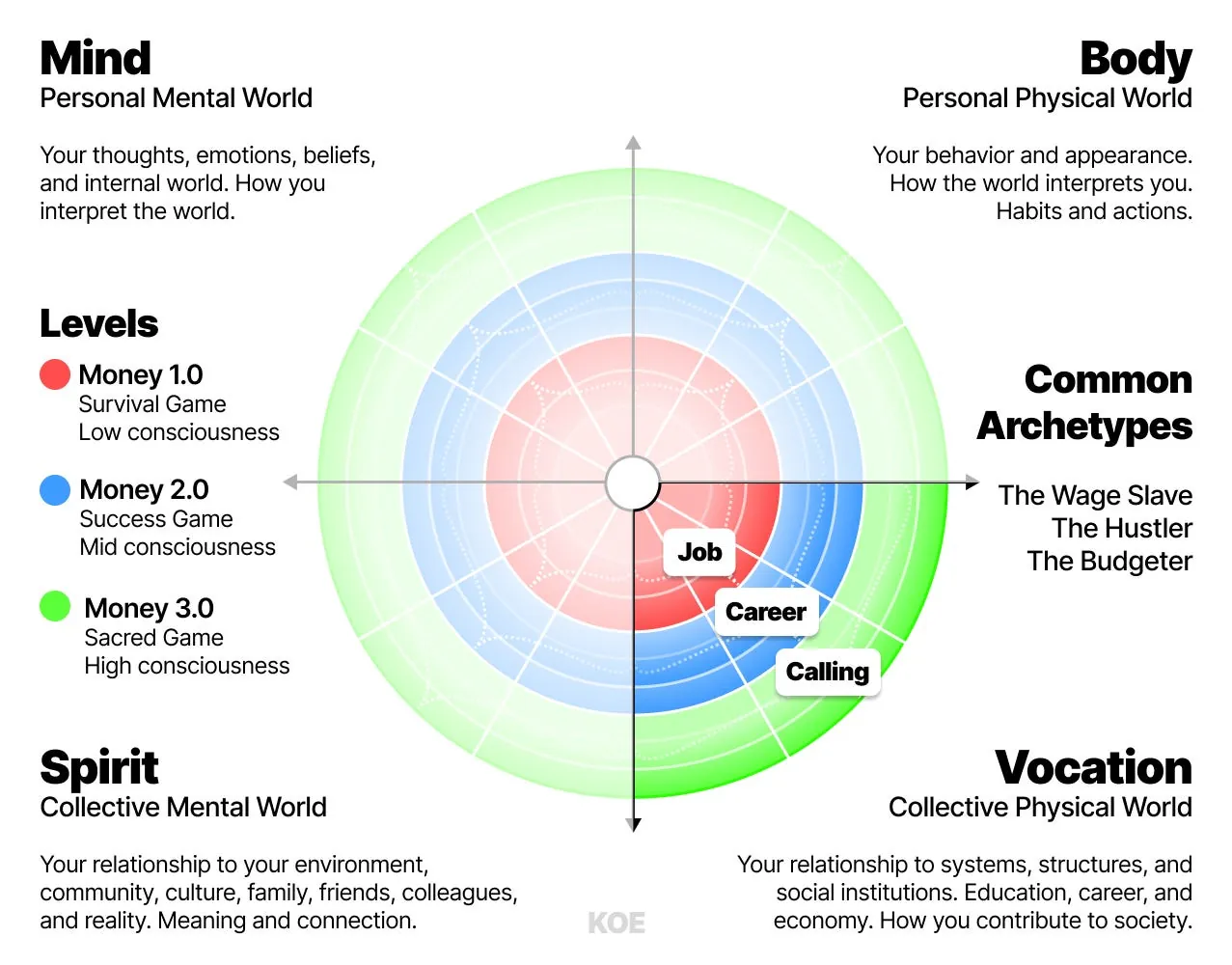
In the information era, Money 3.0 has become possible on a large scale thanks to digital leverage, creative economies, and meaning-driven markets.
The thing is, you can’t just “jump” to level 3 of money in your own life. And there are many people who are in the digital economy who still have survival and success thinking.
The current cultural phase of money is that most people hate their relationship with money while desperately needing it.
Today’s world is filled with archetypal wage slaves, side-hustlers, and budgeters.
I’m not trying to talk down, I am stating the obviously observable archetypes.
In this letter, I want to provide you with a path to overcome your toxic relationship with money, earn enough to escape wage slavery, and ultimately pursue your life’s work.
How To Escape Wage Slavery
The unfortunate reality of Money Level 1 is that it’s extremely difficult to open your mind to see new opportunities.
Work is seen as necessary suffering.
Exchanging time is the only way to make money.
Retirement is the only escape, and you just hope the next 40 years are tolerable.
Most of your relationship with money stems from conditioning from your parents, and if your parents weren’t at a higher level of development, you inherited various patterns like pursuing a high paying job as the end goal, saving your leftover cash in case of emergency, comparing down rather than up (atleast your not homeless!), and unironically hoping that you win the lottery.
Level 1 thinking, as outlined in the Human 3.0 model, is characterized by thinking there is “one right way” to do things, which is often based on what you were conditioned to believe.
Level 1 of money is not limited to a job. But a job is the current and common manifestation of this level of thinking. People can be at Level 3 while having a job, but there are a few requirements.
This low consciousness thinking can start to blend over into your mental experience, preventing development in that domain of life.
Every Monday, you feel a sense of dread.
Every Friday, you can’t wait for temporary relief.
When you check your bank, stress shoots into your system, and you have to constantly calculate how much you can spend.
Even worse, this leads to shadow patterns (behavior that you are unconscious of that will hold you back until resolved). You judge wealthy people as immoral or lucky when that is obviously a wrong generalization. You bond with friends by complaining about your situation, reinforcing your identity. You mistake being cheap for wisdom. And finally, you manufacture drama to feel a sense of excitement in your life, rather than putting that energy toward an exciting goal.
As bad as that sounds, this is a natural level of development.
Everybody starts in Level 1, some just go through the experiences that allow them to develop faster, and others get trapped in it for life. We don’t want that.
The Path To Level 2
Take a marketing coordinator at a mid-size company.
Let’s call him Max.
He makes about $45K a year, has student loans piling up, but at least he “has a real job.” After a long day, he enjoys gaming with his friends. On the weekends, he heads to the sports bar with his friends. At the start of the week, he spends a few days mentally, physically, and often spiritually recovering from the weekend (naughty Max).
Max runs into his old friends at lunch one day. They start talking about money. They’re making triple the amount he is while working at a new tech startup. They suggest getting dinner sometime, but at a restaurant Max wouldn’t feel comfortable affording.
After going home and staring at the ceiling for a bit, he decides to apply for the Senior Coordinator role at his current job. He gets rejected for “lack of experience.” Soon after, the $65K position gets filled by someone external. Someone younger.
The game is rigged.
Monday dread intensifies.
Gaming is his one escape, but it starts to get boring.
“Must be nice,” he says in his head to any mildly successful person he sees.
From that distaste, he decides to do some life math.
3% raises = $52K in 5 years.
Rent prices have been increasing by $200/month yearly.
9 more years to pay off student loans. Interest is accumulating.
Zero savings for a house. Probably still broke by the age of 40. If someone were to come into his life, that financial situation may get worse, and who in today’s world would want to be with him?
Dissonance hits him like a truck.
If he keeps doing the same thing, his life will only get substantially worse.
He buys 10 self-help books. Watches every Alex Hormozi video. Joins 4 side hustle Skool communities. DMs people on social media saying, “teach me how to make money.”
And he only feels more confused.
5 months in, he’s tried dropshipping, crypto trading (loses $500), starting an Amazon FBA store, even tried vibe coding an app.
Then it dawns on him, he has no real skills… except one.
He manages Google Ads at his company. Decides to optimize the current campaigns to practice on the job. His boss starts to notice.
When deciding to pursue your own path, the best place to start is with a pain point, passion, or profession. You already have the experience that can turn into an independent income source. You can solve your own pain point, pursue a passion of yours, or take the skill you’ve developed in your profession and stack new skills onto it.
Max comes across a Twitter thread on how to start freelancing with Google Ads.
Crazy synchronicity.
He doesn’t sleep that night. 6 hours feels like 30 minutes. He starts seeing patterns everywhere. His lunch breaks turn into Reddit research sessions. His commutes are dedicated to YouTube University. His gaming sessions turn into deep work sessions. He can’t help it. He doesn’t even respond to bar invites. His notifications are stacking up with, “Bro, where have you been?”
10 months in.
He says “fuck it,” and sends an email to a local gym.
“I can get you memberships through ads. Only pay me if it works.”
The gym owner takes a chance. First week, 3 new memberships. Second week, 10.
Max just made his first $500 by his own will.
He feels an internal shift. Why would he keep living his same life when this is an option? It’s difficult, and the rejections hit harder than the new clients, but he feels as if there’s something here. He can’t shake it.
Month 13 comes. His side business made half of what his normal job makes.
Month 14 comes. They make the same amount.
Month 15 comes. He quits.
New game, new problems, but he feels alive for the first time in years.
What were the mechanisms behind Max’s success?
How did he launch into level 2?
He went through 3 distinct phases. The phases of development.
-
Dissonance – He got his taste of his current life, it was normal to him. He finally became aware of where his life was heading by mapping it out and observation of unfair events sent him over the edge. He had activation energy.
-
Uncertainty – He used his distaste for his current life as fuel to begin experimenting, even though this was unconscious to him. He learned so much, almost quit, but it finally clicked since he persevered. Skill and knowledge were acquired.
-
Discovery – He realized he did have hidden value to offer, and someone else needed that value. He could focus his energy on one channel and couldn’t break out of it, it sucked him in.
Beyond that, he entered a channel - a period of intense and obsessive development that compressed years of growth into months.
He was pushed into that channel through a glitch – a high-risk accelerant, specifically a life crisis and brutally realizing the life he didn’t want to live.
These phases, channels, and glitches are patterns across all domains, not just money.
If you want to understand levels of development in certain domains of your life, phases you must go through, and tactics to increase growth faster, study HUMAN 3.0.
Once the first payment hit, his identity shifted. He had reached level 2. The persistent results solidified that identity, and that carried him forward for a few years.
How To Pursue Your Life’s Work
Everyone loves the idea of reaching Money Level 3:
Work feels like play. Discipline is the default. Money doesn’t consume your mind, and yet you can make as much as you’d like. You can’t wait to get up in the morning and do what you love to do. You feel a sense of responsibility to your customers. Their success is your success. Learning and earning collapse into one. All prior skills stack up so that you can earn from any of your interests. People tell you to “lighten up and live life,” but you wouldn’t want to be doing anything else. You don’t need an escape.
The thing is, you don’t reach level 3 by imitating it.
False transformation: When someone adopts the appearance, language, or behaviors of a higher level without actually being there. You can be a “manifestation coach” with manipulative sales processes and a desperation for money because you are struggling to survive.
First, you reach level 2 by solving your level 1 problems.
Then, you reach level 3 by solving your level 2 problems.
That’s what development is. If you were to focus on one thing in life to rapidly increase your quality of life, it would be solving problems. That’s it. But the nature of problems is that they don’t appear until the prior problems are solved. Your mind can’t make sense of higher-level problems from a lower level.
In level 1, characterized by survival, you eventually get tired of being regular. You reach a point where you despise living an average life. All of the problems you weren’t aware of surface in an instant, and you have the choice to solve them or remain the same.
In level 2, characterized by success, and once you’ve gotten your taste of that level, you eventually reach a point where you feel empty. The money is great, but you’ve essentially built yourself into a new 9-5.
When people in level 1 hear people say this, they attach to it.
They say “all rich people have meaningless and materialistic lives” in one variation or another. They latch onto that belief and lock themselves in level 1 thinking. They don’t even try to make more money because of a belief, not experience.
Most people trap themselves in level 2 because they think the solution to feeling empty is to stop making money. This couldn’t be any further from the truth. The amount of money you make is a reflection to the level of problems you solve. Money, in level 3, is a reflection of complex development and value.
Take the Loom founder as an example.
He spent years building Loom. He had a purpose. A way to order his mind. Then he sold it for nearly $1 billion and was financially set for life. Soon after, he had an existential crisis and felt depressed. He had essentially stopped solving problems in the Vocation domain of life, and since his identity resided in that level, he didn’t think to dedicate enough energy to others (mind, body, spirit).
The thing is, if Loom was truly his life’s work, it wouldn’t be for sale.
You can make millions of dollars in level 1, level 2, or level 3 - but your relationship with money in each of them is drastically different (survival, success, sacred). All levels can be deeply enjoyable if you do not stagnate. Happiness is resistance being overcome.
How “evil” money is depends on your development in other domains of life. If money is your sole focus and you neglect mental or spiritual development, then you will remain unaware of your civilizational impact. If you are level 1 in mind, body, and spirit, that can easily seep into your pursuit of money.
In the case of Max from above, he could reach a point where he realizes that he’s running Google Ads for a supplement company that scams their naive customers by selling quick-fix “fat burners.” The more Max helps them, the more he harms others in the second order, and if he doesn’t neglect that, he can start to peer into level 3.
if you like this letter, like this letter
Step 1) Have A Meaning Crisis
The first step to change your life is “beating” the level you are in.
But if you haven’t beaten the level, you probably wouldn’t be reading this, or you are reading this out of pure curiosity.
The second step to change your life is becoming absolutely fed up with where you are. In level 1, you get fed up with living by a script your parents or society gave you. In level 2, you get fed up with chasing success and status in isolation. That doesn’t mean you “leave” those levels, it means you transcend and include their most useful parts. Each level is a part of a growing perspective.
So, you need an anti-vision.
You need to start creating your new perspective that you can grow into. You need a positive source of negative energy that pushes you into the unknown.
If you are in level 2, ask yourself:
-
In 5 years, if you doubled your revenue but feel the same emptiness, what does your average day look like? Are you okay with that?
-
What other areas of your life are you sacrificing just so you can make more money?
-
What types of work, clients, or customers make you feel dead inside?
-
What “successful” person would you become that your past self would pity?
-
What does a meaningless calendar look like to you? What about a meaningful one?
-
Who would you become if your only identity was your revenue?
-
What would your relationships look like if the majority of your time was consumed by work you hate?
Let those thoughts trigger thoughts and contemplate where your life will end up if you don’t change.
Step 2) Try Everything & Find The One Thing
Learn and build.
Those are the core habits that anyone in any level must adopt.
The way you move through the unknown is by acquiring knowledge (learning), skill (building), and experience (stepping into the arena). Now that you have an anti-vision (that grows in gravity as you think deeper into it), you have a mind that will start to notice opportunities that may have passed you by before.
The mind is a pattern recognition machine. When you have a frame (an aim for what you want and clarity on what you don’t want), your brain signals important information with an increase in dopamine.
Set aside at least an hour a day for new pursuits.
Read new books. Follow new accounts. Change environments. Build new projects. Any project. Software. Designs. Photos. Videos. Writing. A business. A body. A relationship. A new way of thinking. How can you not feel electric to wake up and have the ability to do whatever you want?
Decrease time spent on money and invest in the development of your mind, body, spirit, and relationships. Your goal during this phase is to immerse your mind in the thoughts and ideas that allow you to expand into a level 3 perspective. Shiny object syndrome is encouraged because you can stack knowledge all day, but if experience lags behind, you won’t learn a thing.
Throughout this process, take mental note of meaningful ideas, habits, and activities you want to make a part of your life.
After 3-6 months, possibly more, you should collect enough clarity to feel confident enough in making a full transition into something new.
This is the best time to deploy tactical stress.
Move across the country. Invest most of your money into a new venture so you feel the pressure to make it work. Put yourself in a do-or-die situation. Most of the time, this will kick you into a period of intense progress, launching you into the next phase of life.
Step 3) Choose A Meta Model For Your Life’s Work
There are hundreds to thousands of ways to pursue your life’s work.
Clearly, I can’t cover all of them here.
But I can talk about one new way that anyone can pursue.
I call it a “meta model,” and you’re looking at it right now.
That meta model is becoming a creator.
Not a content creator per se, but the core of who you are as a human. (We’ll talk about the 3 levels of content creation in the next letter).
Take Jordan Peterson for example (regardless of what you think of him).
He’s not a content creator, but he creates content, because it is one of the highest leverage activities for pursuing his life’s work. He write’s books, has an online academy, has a software, hosts a podcast, and does public speaking. He started with his profession, and amplified that on the internet. He has a meaningful mission to pursue, and uses the best tools at his disposal. Today, those tools are digital.
Every business or entrepreneurial endeavor needs media to some extent.
The amount of power an individual has right now is vastly more than at any moment in the past, and that will only continue to increase. This power transfer has occurred in 3 layers.
The internet gave people access to any and all knowledge. Power transferred away from schools and institutions.
Social media gave people the leverage to attract their own audience. Power transferred away from employers, publishers, centralized media, and even record labels. People can now learn, build, and earn without being dependent on someone else’s authority.
Artificial intelligence is giving people the ability to create, automate, and outsource almost anything. Power is transferring away from traditional gatekeepers and intermediaries. People will soon be able to operate at the level of large teams with a fraction of the manpower.
Why does this matter?
It has allowed for the emergence of meaning-driven markets.
Yes, there are level 1 thinkers that take the shape of influencers and attention hackers, but you can use the same tools to contribute something greater. This new digital leverage has a few components:
-
Zero marginal cost distribution – Share your work with one person or one million for the same effort
-
Permissionless leverage – No gatekeepers, publishers, or institutions required for access to audience
-
Compound growth – Content created once continues working while you sleep, building audience 24/7
-
Global reach – Access to entire planet’s population with wifi, finding the specific people who resonate with your message
-
AI amplification – Tools that multiply creative output, handling repetitive tasks while you focus on unique perspective
-
Direct monetization – Platforms enabling instant payment from supporters without intermediaries
The individual can now pursue any interest or line of work.
If you are interested in something, an entire group of people are.
If you have a pain point, passion, or profession that someone else can benefit from, that’s all the validation you need.
Thanks to technology, an individual can now build what previously required 10-100 person teams:
-
A personal media company (blog, newsletter, podcast, YouTube)
-
An education platform (courses, coaching, communities)
(People don’t hate courses and coaches, they hate level 1 courses and coaches because they are often scams and false transformations.)
-
Software products (using no-code tools, AI assistance, or sheer learning and willpower)
-
Physical products (print-on-demand, dropshipping, small batch manufacturing)
This is possible at any level of money.
Of course, if you are at level 2, or already have money, the transition only becomes easier. The fewer skills you’ve stacked previously in the domain of money, the more learning and building you have to do.
Since I was born in this internet era, that’s where I started. Since I was still in level one, I ended up failing at 7 different business models, getting a job in web design, and eventually looping back to being a creator.
After 5 years of doing this, I can’t say I’m in Level 3, but work has never felt more aligned and enjoyable. I couldn’t see myself doing anything else.
– Dan
Part 5: What The F*ck Is Wrong With Everyone Right Now?
Original: What the f*ck is wrong with everyone right now? — Dan Koe, Sep 17 2025. Mass psychology through the H3.0 lens.
If you’re anything like me, you’re scrolling social media and can’t help but think:
What the f*ck is wrong with everyone?
It seems like everyone became radicalized overnight on both sides.
So, I want to expose the psychology of what’s happening here, and help you take control of your ability to think clearly during crazy times.
In short, this is the result of regression and ideology.
When you go through a stressful event, and if you haven’t practiced the skill of stress mitigation for multiple years, you regress to a lower level of consciousness. You become reactive and animalistic. The worst parts of yourself come out and you may throw away various opportunities you could have had in your life.
You resort to black and white thinking, attaching to a preferred set of beliefs, joining echo chamber tribes that prescribe “one right way” to do or think about things, and if you fall for this trap, your life slowly gets worse for obvious reasons.
This can happen on a mass scale and often occurs in cycles.
When tax season comes around, everyone feels some form of stress.
When political elections happen, those who are sufficiently indoctrinated turn into a completely different person.
When something catastrophic and gruesome is plastered all over social media… you get the point.
And with the internet allowing the spread of information faster than ever, it’s easy to get trapped in this lower level of thinking.
I’m not here to talk about what is right or wrong. I have my views and you have yours. You can find any opinion you want somewhere else. Instead, I want to dissect the mind behind lower levels of human development.
If you understand this, you’ll be able to navigate this emotional wasteland without becoming animalistic and making decisions that could ruin your life.
How highly unintelligent people think
In HUMAN 3.0, I mapped human development across four fundamental dimensions (mind, body, spirit, vocation).
My goal with HUMAN 3.0 was to provide a model for becoming the most developed version of yourself. Multidimensionally jacked, let’s say, rather than becoming overexposed to one domain leading to unconscious problems in others (like a businessman who lacks meaning or a mystic with a frail body).
The result of creating this model has also allowed me to think through complex situations and figure out what I can do about it.
Within each quadrant, there are three macro levels of development. Within each level, there are traits that must be acquired (knowledge, skill, and experience) that move you through the 3 phases (dissonance, uncertainty, discovery) that lead to the next level. For this letter, we are going to focus on the main levels.
These levels represent a person’s level of consciousness, thinking, or development – we will use these interchangeably. They can help you identify where you are in each quadrant, or where you are as a whole.
-
Human 1.0 (The Conformist, Low-consciousness) – Values established authority and traditions. Characterized by narrow-mindedness, black and white thinking, and believing there is only “one right way,” which often stems from childhood conditioning.
-
Human 2.0 (The Individualist, Mid-consciousness) – Rejects the norm and pursues their own goals. Has the desire to acquire status and be perceived as valuable. They are less narrow-minded, but now believe that their way is the one right way.
-
Human 3.0 (The Synthesist, High-consciousness) – Able to adopt multiple perspectives, connect various patterns of reality, and strategize new paths. They understand that all perspectives hold truths that can be synthesized for more holistic and mutually beneficial results. They can display what some may perceive as level 1 traits, such as narrow-mindedness, but it is an intentional choice to tune out noise.
To get these levels, I pulled patterns from various models in developmental psychology such as Ken Wilber’s AQAL model, Susanne Cooke Greuter’s stages of ego development, and Don Beck’s Spiral Dynamics. All of which have shown that the human mind (our values, beliefs, and worldview that influence how we think and make decisions) evolves through predictable stages over time.
Over the next few letters, I want to dive deep on the topics that very few people talk about. I want to dig into the deep reasons behind why people get trapped in lower levels, leading to a poor quality of life and untapped potential. In other words, I want to help you avoid waking up 40 years from now, wondering why you wasted your life.
The massive problem in today’s world is that many people are genuinely at lower levels of development, and they get stuck there.
Even worse, many more people regress to lower levels of development whenever they come across information that sparks a reaction in them, which is dangerously frequent thanks to the internet.
One thing that we have not talked about yet is that there is a Level 0 characterized by pure survival. Very few people reside at this stage in today’s world because threats are minimal, but if a knife were stuck in your neck, you would instantly tap into this survival instinct and fight, flight, or freeze. This helps us realize that levels of development fluctuate and should be seen as tools or perspectives rather than a hard definition for how a human being thinks and acts. In general, you have an average level that you reside in, and we want to improve that baseline.
So, how do you spot these lower levels of development?
Well, it’s not hard to notice.
Like social media comments that state an absolute and often negative opinion without having studied, practiced, or experienced the topic.
After ideating with the HUMAN 3.0 Knowledge Base, I’ve curated a comprehensive list of examples. I’ll share a few of the best ones here. Skim through it if it’s too long.
Information Processing:
-
“That’s just how it is” without questioning why
-
“My parents/teacher/boss said so, therefore it must be true”
-
Rejecting evidence because it conflicts with inherited beliefs
-
“We’ve always done it this way” as the ultimate justification
-
Googling only to confirm existing beliefs, never to challenge them
-
“Common sense” as the highest form of reasoning
Belief Rigidity:
-
“There’s only one right religion/political party/way to live”
-
“People who disagree with me are stupid/evil/brainwashed”
-
Unable to imagine why someone would choose differently
-
Confusing correlation with causation constantly
-
“If everyone just followed the rules, everything would be fine”
-
Conspiracy theories that provide simple explanations for complex problems
Learning Patterns:
-
Memorizing facts without understanding principles
-
Quoting authorities verbatim without comprehension
-
“I don’t need to read about it, I already know”
-
Avoiding books/content that challenge worldview
-
Learning stops after formal education ends
-
Expertise claimed after watching one YouTube video
Work/Money:
-
“Get a stable job with benefits and stay until retirement”
-
“Rich people are evil/lucky/different species”
-
“Thank God it’s Friday” - living only for weekends
-
“Money is the root of all evil”
-
“There’s only so much pie to go around”
-
Playing the lottery as retirement plan
Social Media Behaviors:
-
“Did my own research” = found memes that confirm bias
-
Arguing in comments without reading the article
-
Sharing posts without fact-checking
-
“If you don’t repost this, you don’t care about [cause]”
-
Block/unfriend anyone who disagrees
-
Virtue signaling without action
Cultural/Political:
-
“My country/race/religion is superior”
-
“Kids these days…” / “Back in my day…”
-
“If you’re not with us, you’re against us”
-
“All politicians/media/corporations are the same”
-
Voting against own interests because of single issue
-
“That’s socialism/fascism!” without understanding either term
Technology/Modern World:
-
“Technology is ruining everything”
-
“Natural is always better” (appeal to nature fallacy)
-
Forwarding chain messages about dangers without verification
-
“I don’t trust anything online” while believing everything on preferred platform
-
“AI will destroy/save humanity” (binary thinking)
-
Complete tech avoidance or uncritical adoption
Key Level 1.0 Indicators
-
Quotes but doesn’t think - uses slogans, clichés, and received wisdom
-
Reacts but doesn’t reflect - immediate emotional response without pause
-
Judges but doesn’t understand - condemns what they haven’t examined
-
Knows but doesn’t question - certainty without investigation
-
Suffers but doesn’t change - repeats patterns expecting different results
I think you get the point.
Over the next few letters, I want to illustrate the key mechanisms of low consciousness thinking. That way, you can recognize it and move toward a higher perspective.
Let’s move on to what we’re really here to talk about.
The most dangerous trap to becoming the ultimate version of yourself
The first and foundational mechanism that traps people in lower levels of development is ideology.
Here’s the definition we are going to run with:
An ideology is a cohesive set of beliefs about reality, often containing stubborn intellectual attachment to those beliefs and normative prescriptions for how others should behave.
A few obvious examples are religious, political, and scientific ideologies.
In Fundamentalist Christianity, the bible is the literal word of God, and everyone should accept Jesus as their personal savior.
In Progressive Socialism, capitalism inherently creates inequality and exploitation, and wealth should be redistributed through high progressive taxation.
In Scientific Materialism, consciousness emerges from brain activity and nothing more, and policy decisions should be based solely on scientific evidence.
But ideology goes far beyond that.
Those who don’t think they are ideological are often the most ideological. Atheists, as an example, may not believe they are because they don’t subscribe to common thought, but they can often be more closed-minded than the rest. Even Buddhism, whose core teaching is being non-ideological, is often interpreted as law by level 1 or 2 thinkers.
Even further, there are diet ideologies like carnivore, veganism, paleo, flexible dieting, or how seed oils are bad. There are training ideologies like CrossFit, bodybuilding, running, and yoga. There are Apple ecosystem fanboys who only buy iPhones and Macbooks, minimalists who downsize their lifestyle, homeschoolers, gamers (PC supremacists vs Xbox supremacists), and many more with gender ideology occupying plenty of mind share.
Obviously, some of these are more dangerous than others, but notice how each ideology:
-
Claims universal truth without critical thought
-
Prescribes behavior to everyone
-
Demonizes opposing views
-
Offers simple solutions to complex problems
-
Creates tribes with moral superiority
-
Demands conformity over independent thinking
As we’ll learn, ideology is not always bad.
Level 1 thinkers attach to ideology for survival and fitting in, so they don’t become an outcast. They have an external locus of control, placing responsibility on a God, authority, government, or anyone but themselves to make decisions and act to solve problems. They protest for change rather than going through the difficult series of steps to make the change.
Level 2 thinkers attach to ideology for power and success, so they can achieve more. They have an internal locus of control and hold personal responsibility as a value. They take it upon themselves to solve problems, often to their own detriment.
Level 3 thinkers use ideology to synthesize truths and make calculated decisions. Ideology becomes a tool. They understand systems and their place in it, acting on what they can control and advocating for systemic change.
When society regresses on a mass scale during periods of stress, the first thing they do is seek comfort in their preferred ideology and blame the problem on either an external authority or themselves.
And since comfort is addictive, ideology can be sold quite easily, leading to big consequences.
if you like this letter, like this letter
Why ideology can make your life substantially worse
It’s easier to fool people than to convince them they’ve been fooled.
Ideologies sell well because they provide simple answers, and most people aren’t willing to bear the emotional and intellectual responsibility of nuance and truth.
At times this isn’t that bad.
Jordan Peterson and Richard Dawkins are ideological in their own ways (as am I, and as are you), but they are often focused on education and encourage you to dig deeper into a domain of knowledge.
Ideology becomes harmful when pushed to the extreme, like religious extremism leading to terrorism or political extremism leading to genocide.
However, ideology of any form, when it becomes a non-negotiable part of your identity, can stunt your psychological growth, cause cognitive damage, and even lead to social or cultural harm.
As humans, our survival instinct has evolved to the conceptual level.
Meaning, when you identify with an ideology – like Christianity or even attaching to your favorite sports team – you quite literally feel threatened when the idea of those things are threatened.
If someone tells a Christian “God’s not real,” it emotionally feels like they’ve been slapped in the face, so they tend to lash out with the doctrine that has conditioned their mind because that’s how they survive. They attack with concepts, not fists. (We’ll talk more about survival as a low-consciousness mechanism in a future letter. That one’s important.)
Seems like a normal part of life, because it is normal for a population that is low consciousness on average.
But this leads to closed-mindedness, emotional volatility, and mental addiction. You don’t learn because you don’t inquire further. You become defensive and fearful from a few words. And the quick and easy defense of regurgitating what an authority told you gives you a cheap dopamine hit, so you continue doing it.
Ultimately, this prevents self-reflection. You rarely notice or correct your mistakes. 10 years pass by and while you’ve physically aged, mentally you’ve stayed a prepubescent teen with turbulent hormones. You think in black and white and never step closer to truth.
By the way, I’m not against any ideology in particular that I’m criticizing here. In fact, I really enjoyed this tweet I saw yesterday and relate with it quite a bit:
As a Dawkins-era atheist I underestimated Christianity’s role as a civilisational operating system.
I took its moral foundations for granted, assuming they were so self-evident that all humans would reach them once basic needs were met.
– Andy @PositivFuturist
I’m not an atheist (anymore), but I’m not a Christian either (I was raised Mormon). That said, understanding those perspectives and more has given me a deeper look into God and reality that I’m grateful for.
Now, on the personal level, ideology clearly makes life substantially worse.
But individuals compose the collective, and when a society of ideological people collide, the outcome can be catastrophic.
First, it leads to polarization that fragments society into antagonistic groups. Most world violence stems from this. Most intolerance for others does as well. Very few people realize that different cultures are built on different values. Sure, it sounds nice to project your beliefs, but if you were born and raised in another culture across the world, you would have their values.
You can argue that you’d believe the same things you do now, but the reason you believe them is because you were conditioned to believe them. You weren’t born with those beliefs. They were installed into you.
Lastly, ideology stalls progress (scientific, technological, environmental, political) because it prevents real solutions to complex problems. Everyone believes they already have the simple solution of “just joining their ideology.”
How to avoid becoming a drooling bag of regurgitated beliefs
The key distinction between useful ideology and harmful ideology is treating it as a tool instead of law.
The problem isn’t the content of the ideology. It’s not about whether you believe in God, science, or feminism.
The problem is attachment. The mode of holding beliefs. The content becomes a static context by which your mind always operates. Once you can’t see out of the set of beliefs, you are metaphorically dead, because you do not grow. A plant that isn’t growing is dying.
The solution is to have firm beliefs held loosely.
To hold every idea in the realm of possibility so that you have a pool of truths to pull from when it comes time to make progress or solve a problem.
You can have strong opinions without being ideological about them. This alone removes a lot of pain and unnecessary negative emotion from your life because you’re willing to be wrong.
Ideology as a tool is almost a necessary function of being human. Our mind craves order and structure, but it must also go through periods of uncertain growth to expand into a more complex structure. That’s what psychological growth is. You need direction and purpose from structure, but even the strongest buildings rot away over time. You need to move and build.
Ideologies contain genuine insights and wisdom, i.e.
-
Buddhism contains profound teachings about consciousness and suffering
-
Christianity offers valuable moral insights and community building
-
Environmentalism highlights crucial ecological concerns
-
Veganism, as much as people don’t want to admit it, shines a light on ethical truths about reducing harm
That said, when one of these becomes the only solution, you just end up looking and sounding like an idiot. You don’t have to be a vegan to care about ethical truths. You don’t have to be a buddhist to care about consciousness. So on and so forth.
The goal of becoming non-ideological is to also be non-ideological about being non-ideological. As much as your mind wants to latch onto a set of hard and true beliefs, because that’s how our survival mind is wired, our current environment demands that more people advance to the third level of thinking.
How do you do this?
First, contemplate. Question all beliefs and assumptions deeply. It will be painful, but most people have never done this. Like or comment on this letter and I’ll create a non-dogmatic AI prompt that will brutally deconstruct your beliefs.
Second, expose yourself to radically different perspectives and practice non-reaction. Hold those ideas in the realm of possibility. Research all sides of an issue and try to connect the dots.
Third, self-reflect. Notice times when you’ve regressed to a lower level of thinking after a stressful event and consider whether or not it was the end of the world like you thought it was. Most of the time, it wasn’t, and time just went on.
Fourth, deconstruct. Study all perspectives and attempt to deconstruct them into independent parts. Remove the idea from the ideology and piece together new ones.
Fifth, synthesize paradoxes. Life is counterintuitive, and some of the greatest thinkers can hold two contradictory ideas in their mind until they collapse into truth.
Sixth, become a bridge. Instead of arguing which ideology is “right,” translate between worldviews. One of my own greatest strengths, I think, is to articulate religious concepts and new age spirituality in a practical way. Most people don’t even notice that 90% of my newsletters involve this because I talk about them in a clear way.
Seventh, create new contexts. The ultimate Level 3.0 move is generating entirely new frameworks that render old debates obsolete. Like how Bitcoin created a better solution rather than arguing and complaining about banking reform. You are a creator, act like one.
How do you know when you’re starting to reach level 3?
1) You can steelman better than your opponents.
You can argue their position more persuasively than they can, because you genuinely understand it.
2) You create more than you consume.
Instead of endlessly debating existing ideas, you’re generating new ones that make old arguments irrelevant. This takes years of doing.
3) Your former enemies become teachers.
You no longer hate a specific ideology and instead see what developmental levels it serves and which people need it at those levels. Like in business, “sleazy sales” is often just a bridge into building something truly valuable.
4) You play with perspectives.
You can shift between basic teachings and complex strategy when the situation demands it. You’re probably not going to solve a business problem by demanding that everyone at your company study Buddhism.
5) Problems become fascinating instead of threatening.
At level 1, problems are threats to survival. At level 2, problems are challenges to conquer. At level 3, problems are the limits on potential. They are puzzles that, once solved, create new possibilities, and thus new problems, that keep humanity moving forward.
Thank you for reading this letter.
I’m having a lot of fun with these lately.
Part 6: You Won’t Be The Same Person In 6 Months
Original: You won’t be the same person in 6 months (how to master anything, fast) — Dan Koe, Sep 23 2025. Rapid skill acquisition and reinvention.
Most people, even though they don’t know it, are asleep. They’re born asleep, they live asleep, they marry in their sleep, they breed children in their sleep, they die in their sleep without ever waking up. They never understand the loveliness and the beauty of this thing that we call human existence. – Anthony De Mello
People are living on autopilot.
Everyone was assigned goals by society as a child.
Goals require a system to be achieved.
A system takes trial and error to become efficient.
You had the biological goals of walking, talking, and speaking to survive.
As simple as they are for you now, that wasn’t always the case.
Your mind received negative feedback from your environment, which led to those systems becoming efficient to achieve your goal of surviving.
Your parents either scolded you or pointed you in the right direction when you made a mistake.
You started crawling, then stumbling around, then walking like a toddler with little balance, and now you can (hopefully) walk like an Olympic gold medalist can flip through the air and stick the landing – because they practiced achieving that goal long enough.
Learning to walk is just the start.
What about the goals of going to school, getting a high-paying job, and retiring at an age where you have little time left to enjoy your life?
Society as we know it is a system with the goal of creating useful workers and obedient citizens, because without them, the authorities and rulers would lose power.
Those are the 3 big goals – school, job, retire – that they injected into your mind right when you learned to comprehend the language you speak.
99% of people only see the 1% of reality that reinforces their beliefs and helps them achieve those goals. Much of their zest for life is extinguished by 25 years old.
99% of people are learning the skills and conditioning their minds to live a mediocre life, and they don’t even know it.
The masses are being shepherded to an unfulfilling life because the systems that compose their mind, identity, perspective, and perception are becoming more efficient as they age.
A realization people often make too late:
Success is not planned, it is automatic.
Successful people – whether they were conscious of it or not – had a mind that was programmed to achieve the goals that led to their success.
Here’s how you dissect your mind and reprogram it to become the highest version of yourself.
The root of all human behavior (and why you can’t seem to change)
Your identity is not who you are, it’s a collection of survival strategies.
In last week’s letter, I promised that I would write about the core psychological mechanisms that keep people trapped in a low-consciousness state.
That letter was about ideology, and we broke down:
-
Mass regression during stress: When people face stressful events (via a one of catastrophe or cyclical events like elections or tax season), they regress to lower levels of consciousness, becoming reactive and resorting to black-and-white thinking and ideological attachment.
-
Three levels of human development: Level 1 thinking (Conformists who value authority/tradition), Level 2 thinking (Individualists who reject norms but believe their way is right), and Level 3 thinking (Synthesists who can adopt multiple perspectives and use ideology as a tool).
-
Ideology as the primary trap: Ideology provides simple answers to complex problems and becomes harmful when it becomes a non-negotiable part of identity, leading to closed-mindedness, emotional volatility, and stunted psychological growth.
-
Attachment vs. content problem: The issue isn’t what ideology you believe in, but how rigidly you attach to it - treating beliefs as absolute law rather than tools for understanding. Humans need direction and purpose, but they need to outgrow psychological infrastructure that no longer serves them.
-
The Solution = Firm beliefs held loosely: Hold ideas in the “realm of possibility” rather than as absolute truth, be willing to be wrong, and synthesize truths from multiple perspectives.
-
Level 3 thinking indicators: You’ve reached higher consciousness when you can argue opponents’ positions better than they can, create more than you consume, see former enemies as teachers, and view problems as fascinating puzzles rather than threats.
-
Path to advancement: Question all beliefs deeply, expose yourself to radically different perspectives, practice non-reaction, deconstruct ideologies into parts, synthesize paradoxes, and create new frameworks that make old debates obsolete.
In HUMAN 3.0, I mapped human development across four fundamental dimensions (mind, body, spirit, vocation).
My goal with HUMAN 3.0 was to provide a model for becoming the most developed version of yourself. Multidimensionally jacked, let’s say, rather than becoming overexposed to one domain, leading to unconscious problems in others (like a businessman who lacks meaning or a mystic with a frail body).
To create this model, I pulled from flow and performance science, various philosophical schools of thought, and developmental psychology research from Clare Graves which turned into Spiral Dynamics, Susanne Cooke Greuter’s 9 stages of ego development, Maslow’s hierarchy which shows that higher needs emerge once lower needs are satisfied, and Ken Wilber’s AQAL model that orients generalizations, creating a useful, non-dogmatic theory of everything.
Here’s the key problem that we’re here to talk about:
If you don’t expand your consciousness (in other words, develop your mind, body, spirit, and vocation) your life will be unnecessarily difficult and painful.
You’ll wake up being 50 years old with the psychology of a 14 year old going through an emotional puberty, always reacting to problems and never being able to solve them. And thanks to the digital and physical modern environment, you end up addicted, overweight, broke, purposeless, and bitter.
Since ~80-90% of the world are at lower levels of development, this creates a low consciousness collective where nobody wants to actually solve problems, they simply want to fight until the other side loses.
Ideology, as discussed in the last letter, is one mechanism keeping most people trapped in this destructive state.
Survival, on the other hand, is the root of it all.
Every level of development is, in essence, changing how you survive.
If you can master your survival and leverage it in a way that is advantageous to a high quality of life, you unlock the core “cheat code” to achieving what other people think is impossible.
Your ego is a collection of survival strategies
Please do not downplay how important this is.
Survival is the mechanical, often unconscious, engine behind every thought, emotion, and action.
Everything you think, feel, or do is rooted in survival.
I repeat, your entire human experience, right now, is directed by survival. This is one of the most important topics you can understand to change your life, because this is what got you into the current situation you’re in.
You cannot win the survival game, you can only transcend and include it. Trying to win the game is the ultimate source of suffering.
Here’s where it gets tricky:
Animals survive on the physical level. They attempt to reproduce the information in their genes.
Humans do this as well, but our survival extends beyond the physical world into the psychological world. We survive with our body, but also our identity. We try to reproduce the information in our genes, but also the information in our consciousness (memes).
So, what we’re concerned with here is conceptual survival – the drive to preserve one’s non-physical identity.
Animals use claws, teeth, and camouflage to survive, but humans are more deeply invested in the survival of their concepts: their self-image, beliefs, values, and worldview. As illustrated in the Ideology letter, this is why we attach to belief systems and defend them like our life depends on it, because to our mind, our life does depend on it. The ego perceives threats to our concepts as a life-or-death threat, triggering the same fight-or-flight mechanisms as a physical attack.
Our bodies are composed of genes. Our psyche is composed of memes. A meme is a unit of culture or an idea that spreads from mind to mind. This is an extended phenotype (a gene’s expression is not limited to it’s body but reflects in it’s environment, like a beaver’s damn aiding in survival).
We create larger structures like religions, nations, political parties, and corporations. These institutions are “nests” built to protect, perpetuate, and replicate the memes they are founded on.
If you are a gamer and somebody says video games are bad, you lash out in defense.
If you are a democrat and a republican calls you an idiot, you do the same.
If you identify with a sports team, religion, fad diet, or really anything else, you can’t help but want to attack those who come into conflict with those things.
The core problem here is that you are unaware of this. It happens mechanically. Automatically. Your life is a series of unconscious reactions rather than conscious choices. You are more animal or robot than you are human.
we’ll continue with this low-consciousness mechanisms series in the next letter when we talk about self-bias
Why it’s so damn hard to change your life
Think of your identity or self-image like a house or building.
If you wanted to remodel it inside out, would you start ripping down walls or pulling out the foundation?
Of course not, the entire house would crumble, especially if you don’t have the relevant skills.
Instead, you start with the floors, maybe the plumbing, then tear down one small wall, redecorate the inside, give the outside a fresh coat of paint, and slowly you don’t even recognize the house.
So, every time you try to:
-
Wake up earlier (threatening your “night owl” identity)
-
Start a business (threatening your “employee” identity)
-
Eat healthier (threatening your “comfort food” identity)
-
Be more social (threatening your “introvert” identity)
You’re essentially trying to replace a wall in your psychological house.
It’s painful. It exposes vulnerable parts of you. And if you don’t have an understanding of survival like we just discussed, you’ll quickly retreat back to comfort until your house starts rotting from the inside and your life gets worse and worse thanks to entropy.
We’ll save the concept of psychic entropy for a different letter, but understand that a system naturally declines into chaos unless effort or energy is put into maintaining order (remember, your mind is a series of nested systems). If you don’t pursue growth and improvement, naturally, your life only gets worse until it’s incredibly difficult to dig yourself out.
In other words, if you don’t remodel your house, it eventually rots. At first, some chipped paint and maybe a roach don’t bother you, but if you let that small problem slide by, it gets much bigger. Either way, as time goes on, you’ll eventually need to build a new house or move altogether, no matter how much effort you put into maintenance.
If you truly want to change, it’s going to be a painful journey.
But if you have the right strategy, you can expect and mitigate that pain, making it easier to reach a higher level of consciousness faster.
The Mastery Method (How To Learn Anything, Fast)
The Mastery Method is a framework for acquiring knowledge, skill, and experience fast.
What most people don’t understand is that in order to master anything, you must master and transcend your survival, because in the process of mastery, you become an entirely different person.
You need to let go of your past life to open up room for a new one.
So, it’s safe to say that you are going to have to learn… a lot.
Learning is the foundation, because right now, your self-image that is so desperately trying to preserve itself is preventing you from doing so.
Education expands your mind.
It introduces you to novel perspectives.
It increases dopamine in the brain as a consistent source of energy.
It gives you the knowledge to act with clarity toward your goals.
It exposes you to the potentials that you hadn’t yet become aware of.
A consistent flow of education increases your chances of encountering meaningful events.
Meaningful events occur at the edge of the known, when your nervous system signals that you should pay attention and act on the opportunity.
When you have one foot in the unknown, you can just barely metabolize new aspects of reality and put that information to use.
Every skill you learn, every piece of knowledge you acquire, is either reinforcing your current survival strategies or helping you transcend them. You are extremely skilled at staying the same. We need to change that.
Becoming the person you were meant to be is the most painful yet rewarding process you can dedicate your life to.
You begin this path when you realize that the pain and pleasure of where you are now are of lesser magnitude than the pain of not receiving the rewards that come from seeing what you are capable of.
With that, let’s discuss how to master almost anything as you trek toward becoming a new you:
1) Expand Your Mind
All real change is identity change.
Your level of mind dictates what values, beliefs, and standards are available to your identity.
You don’t care about global problems because you haven’t solved the personal problems that restrict your mind from seeing them as important.
Most people’s minds are trapped in level 1, low-consciousness thinking. They can only see threats and opportunities that impact their physical or psychological survival. You’re focused on your own personal gain.
If we pull from the great belief systems and philosophies, one common pattern is that the purpose of life is to continually expand your consciousness beyond yourself.
So, that’s step one.
To break out of level 1 thinking, you need to peek into level 2 thinking, then level 3.
You must allow yourself the room to discover new goals by tossing an anchor into the unknown.
How do you do that? You set a massive goal in one of the 4 dimensions (mind, body, spirit, vocation). For most people whose biggest problems are their weight, energy, confidence, or finances, starting in the body or vocation quadrant is usually the smart way to go. I started with fitness, and the benefits of that spilled over into every other domain.
The thing is, you don’t set this goal for practicality or achievement.
That’s not what goals are for. A goal is a point of view. Achieving goals = solving problems = acquiring perspective = expanding consciousness (by the way, goals are not only materialistic pursuits). You don’t appreciate the journey without first reaching the destination.
You set this massive goal for vision, direction, and filtration of opportunities.
Focus on making it as desirable as possible.
If you don’t know where to start, answer these questions, or fill out this Life Reset prompt and it will spit out a first version of your plan to reach your next level.
-
If you had all the money in the world, what would your average day look like?
-
What kind of environment do you want to live in? Is there a specific location? Do you want to travel?
-
Do you want a family? What do you want that life to look like? Visualize an average day of family time.
-
How long of a workday do you want to have? If you could do anything, what would you do for work?
-
How do you want to look and feel? Describe your body, energy levels, and how you want to present yourself to the world.
-
What does your ideal day look like? Map out every hour.
-
List out anything else that comes to mind in terms of a specific future that you want to build for yourself.
To make this even more potent, turn this vision into an anti-vision to round out the perspective of your ideal self:
-
What is the bane of your existence?
-
Write out the opposite of every question about your vision.
For even more firepower, create a vision board. Add images to a scrapbook, software, or wall that makes that future more tangible.
Remember that nothing is permanent.
You will discover inklings for your vision as you trek along this path. Be open to changing what you want as you discover what you don’t want.
The pain of not reaching your vision should outweigh the pleasure of mediocrity.
Filter every single opportunity you receive through your vision.
Say “no” to everything except for that which aligns with who you want to become.
2) A Hierarchy Of Goals
When a person invests all her psychic energy into an interaction—whether it is with another person, a boat, a mountain, or a piece of music—she in effect becomes part of a system of action greater than what the individual self had been before. This system takes its form from the rules of the activity; its energy comes from the person’s attention. But it is a real system—subjectively as real as being part of a family, a corporation, or a team—and the self that is part of it expands its boundaries and becomes more complex than what it had been. – Mihaly Csikszentmihaly
Most people don’t need motivation, they need clarity.
An ordered mind is a happy one, and a hierarchy of self-generated goals makes it hard for depressing distractions to penetrate your awareness.
While big goals are for vision and filtration, small goals are for practicality and progress.
Now, break your massive goal down into tangible sub-goals.
-
10-year goals
-
1-year goals
-
Monthly goals
-
Weekly goals
Then, every day, you are going to write down 3-5 priority tasks that move the needle toward these goals from the ground up.
Knock these tasks out first thing in the morning before responsibilities and distractions have time to wake up.
This daily practice literally rewires your survival patterns. Instead of waking up in reactive mode, you wake up in creative mode.
3) How To Learn
Learning comes from struggle, not memorization.
You don’t learn by studying tutorials all day.
You learn by building a project and facing reality.
True learning threatens your current identity while false learning (found in schools and institutions) reinforce it. That’s why it feels uncomfortable. Your survival systems resist new information that doesn’t fit your current worldview. But when you’re building something real, you can’t hide behind theory.
Projects are goals that you can measure and iterate.
So, turn a few of your 1-year or monthly goals into a project.
-
Ideate a way to build something tangible (you must do work)
-
Write down milestones you can reach
-
Create an outline in a notes app or notebook
-
Brain-dump any ideas that come to mind
This primes your mind for pattern recognition-induced meaningful dopamine.
Your projects add additional “rules” to your perception of situations.
You now have a place to write down high-signal information that you receive as you educate yourself and interpret feedback while building.
Start, then learn. You must learn and build in unison to truly learn.
When you build something, you encounter real problems that require a new level of mind to solve.
Only then can you search for information to expand your mind and solve those problems. This is impossible when watching tutorials all day.
Each problem you solve is a small evolution. You literally couldn’t have solved it from your previous level of consciousness.
4) Skills Are Groups Of Techniques
Building a project isn’t the end of learning.
To build a project, you must acquire skills along the way.
But you don’t “learn a skill.”
You learn a technique, experiment with it, and continue adding techniques until you can combine them in a way that leads to your desired outcome.
Each technique you master is a tool that makes you less dependent on your current survival strategies. The more techniques you have, the more options you have beyond fight, flight, or freeze. You move from having one hammer to having an entire workshop.
You don’t learn Photoshop as a skill.
You create a project, search for a technique to complete one aspect of it, and continue learning techniques until you finish the project.
Trying to learn the software itself is almost useless and takes much longer.
There are 10+ different techniques to remove the background of an image.
Knowing multiple techniques will allow you to remove the background seamlessly from almost any scene.
You don’t learn copywriting as a skill.
You learn techniques for:
-
Capturing attention
-
Holding attention
-
Enhancing the perceived value of your product or idea
-
Moving beyond survival-based triggers to creation-based inspiration
There are dozens of techniques for each, and the more you learn, the better you get at copywriting as a skill.
Everything is a skill.
Life is a skill that encapsulates health, wealth, and relationships as skills until broken down into techniques you can practice over the course of your life to master life itself.
5) Reinvent Yourself
Think of your mind as the digestive system of reality.
If you eat too much or don’t move enough, you won’t metabolize that experience.
If you eat too little or move too much, you get hungry and agitated.
When you eat just enough, you create an environment that is conducive to mental muscle growth. You slice through reality toward your goals. You enter a season of pure progress, and the feeling is incredible.
Intentionally reinventing yourself is controlled identity death and rebirth. Your old survival strategies will fight this process because they perceive change as a threat. But this resistance is signal. It’s a sign to lean into the discomfort (when most people would shy away).
You’ve already created the boundaries, limits, or clarity necessary to launch fairly far into the unknown. Risk has side effects, but risk can be mitigated with knowledge and skill.
With a vision, goals, and projects you are primed for an entirely new life.
All you have to do is take the leap.
Launch yourself into a new physical or digital environment.
-
Move across the country
-
Unfollow everyone online
-
Follow people aligned with your future
-
Change what you wear, where you shop, and who you see
-
Drown your mind in the books you’ve been putting off reading
Align all information, or reality, with who you want to become.
Your old identity will die because it is starved of the information that reinforces it.
Hold strong during this extremely difficult yet extremely meaningful turning point in your life.
6) Nature’s Compass
People are so afraid of making mistakes that they make the biggest mistake of them all: not making mistakes.
You can’t avoid making mistakes.
They are Nature’s Compass.
People who don’t make mistakes don’t give themselves a chance to achieve successes.
Imagine a self-driving car.
For years, it has received negative feedback that refines the system that shapes the mind of the car.
It can navigate roads with ease and may be arguably safer than a human driving the car.
Even though we often don’t think of it like this, the self-driving car made millions if not billions of mistakes before it could actually reach a meaningful destination.
You must act in alignment with your big goal to form new systems that your mind operates on through the negative feedback of mistakes.
-
Make a habit of forcing yourself to adopt the perspective of the highest version of yourself
-
Allow this lens to unveil new opportunities that you can act on
-
When you make a mistake, because you will, use it as direction for your next choice
-
Notice which mistakes come from operating at lower survival levels
You will be able to achieve what most people think are difficult goals like you are able to walk (while most are still crawling).
7) Self-Experimentation Solves Problems
Your life and the projects that compose it should be treated as science projects.
To solve the problems that achieve your goal:
-
Hypothesize an outcome (from your goals)
-
Experiment with techniques (for skill acquisition)
-
Document the process (as a project)
-
Double down on results (as a solution)
Now, you have experience, skills, a project you can turn into a product, and a solution that you can charge money for to create an independent income source.
Self-experimentation is the only way to solve your problems for good.
Let’s say you have the goal of achieving a six-pack.
You are in search of a solution, they tell you that veganism will solve all of your problems, and from an unenlightened state you:
-
Clean up your diet
-
Follow their advice as if it were law
-
See the results they mentioned
Then, you attach to that diet ideology and become a prophet. You attribute results, that others have gotten via different modalities, to veganism and demonize anyone that questions you.
This is dangerous, obviously, and is the definition of low consciousness – operating from tribal survival rather than conscious choice.
In reality, what happened is independent of veganism:
-
You ate more nutrient-dense foods
-
Your actions worked to survive your vegan identity
-
You had clarity (not chaos) by following a disciplined nutrition regimen
Veganism, in this case, was simply a modality for ordering your mind and allowing you to follow the principles of health – but you attributed it to a method.
Now, if you were to try veganism for a month, carnivore for a month, keto for a month, and flexible dieting for a month, you would:
-
Make connections between the diets to reveal the fundamentals of health
-
Pick and choose certain methodologies that you enjoy, meaning they will bring sustainable results
-
Refine a system that fits your individual nature to perfection
-
Transcend dietary tribalism into conscious nutrition
Then, once healthy living becomes effortless, you can do the same for your finances, social life, romantic relationships, spiritual endeavors, or any other domain of life.
Think of each domain of your life as both a project and a skill in which you collect techniques to master that domain.
The Mastery Method: Summarized
This is how you achieve goals so fast people ask for your cheat code in the game of life:
-
This is how you achieve goals so fast people ask for your cheat code in the game of life:
-
Expand your mind with a vision generation session. This perspective will allow you to create new goals and discover new potentials for your life (so you can break out of your narrow mind and achieve more).
-
Create a hierarchy of goals to bring clarity to your life. You need to bridge the gap between where you are now and where you want to be with practical goals.
-
Turn your goals into projects so you can build and learn in unison. Projects are goals that are measured, tracked, and improved.
-
Don’t learn skills, acquire techniques. Your skill level depends on the amount of techniques in your toolbox that can solve challenging problems.
-
Reinvent yourself with information overload Change your physical and digital environments to force an open mind and discovery of new potentials.
-
Treat mistakes as negative feedback in your system. You have no other way to test something that gets better results.
-
Treat your life as a science project. Become obsessed with experimentation in fitness, business, knowledge, and relationships.
Until next week,
Dan
Back to Blog